Overview
The Dead Sea lies in the Jordan Rift Valley between Israel and the West Bank on its western side and Jordan on its eastern side. It is a landlocked salt lake, not an ocean sea. Travelers reach different shores through different countries, border rules, roads, beaches, and tourism systems, so “going to the Dead Sea” is not one interchangeable route.
Use the Israel planning hub for the western shore before choosing a hotel or beach.
Use the Jordan planning hub for the eastern shore.
Where is it on the map?
North ↑
the West Bank
Sea
The lake runs roughly north to south within a deep basin of the Jordan Rift Valley. Jerusalem is west of the northern half. Amman is northeast of the lake. The Jordan River enters at the north, while the Arava valley continues south toward the Red Sea region.
The shoreline itself changes as the water level falls. On 4 October 2026, the Israel Water Authority recorded the water surface at 441.50 metres below mean sea level. That is a dated measurement, not a permanent elevation. A map that uses a much older shoreline can place water where exposed ground now exists.
The Dead Sea has two national travel systems around one lake. Israel and Jordan share the geography, but not the same roads, beaches, buses, entry rules, or hotel inventory. Choose the country side first, then plan within that shore instead of mixing destinations from both.
Which countries border the Dead Sea?
Jordan borders the eastern shore. Israel and the West Bank lie along the western side. The international and administrative geography matters because a place name on one shore does not imply direct local access from the other.
Choose the shore you plan to visit. The Jordan Dead Sea guide covers the eastern shore.
The Israel Dead Sea guide covers western shore planning.
A visitor cannot simply drive across the lake. Moving between the two countries requires an appropriate land border crossing and compliance with current entry rules. Border status, opening hours, visas, transport, and rental car restrictions must be checked for the travel date.
Where do travelers stay on the Israel side?
Ein Bokek and Neve Zohar form the main southern resort area on the Israel side. This is where visitors find the largest concentration of hotels, declared beaches, and visitor services. Start with the Ein Bokek guide if a resort stay is the priority.
The northwestern shore includes managed beach venues and Qumran in the West Bank. Farther south, Ein Gedi and Masada are in Israel; each has its own access rules and is not a bathing beach substitute.
Use the Israel hotel directory for properties on the western shore.
The separate Jordan hotel directory keeps eastern-shore properties in the correct travel system.
Where do travelers stay on the Jordan side?
Jordan’s principal resort zone lies along the northeastern and eastern shore, within driving reach of Amman and Queen Alia International Airport. Hotels and day access venues operate within Jordan’s own tourism system.
Use the Jordan day pass guide when you are not staying overnight.
The Jordan day pass comparison explains the difference between a hotel day pass, a beach venue, and a tour inclusion.
Do not use an Israel beach page to plan a Jordan visit, or vice versa. Even when the view across the water looks close, the practical trip is governed by the shore you are actually on.
Why is the Dead Sea so far below sea level?
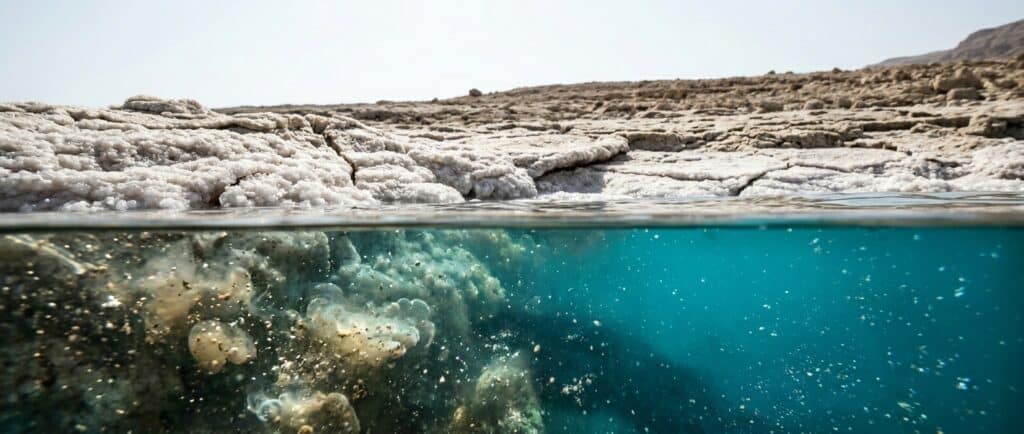
The lake occupies a deep tectonic basin along the Dead Sea Transform. Water flows into a closed basin but does not continue to an ocean. In the hot, dry climate, much of that water leaves through evaporation, concentrating dissolved salts.
The Dead Sea water surface is often cited as the lowest natural land-or-water surface elevation, while exposed shoreline lies slightly higher. Its exact value changes, and the lake floor lies farther below. Learn how those measurements differ in the Dead Sea size guide.
The falling level also changes access. Do not follow an old shoreline track or walk across unmanaged exposed ground. Sinkholes and unstable surfaces occur in affected areas, so use current managed beaches, roads, and signed attractions.
“Below sea level” describes vertical position, not depth alone. The water surface can sit hundreds of metres below the global ocean reference while the lake itself extends farther down. Always attach a date to the surface elevation because the shoreline and level continue to change.
How large is the Dead Sea?
There is no single timeless area. A 2026 remote sensing study mapped about 592.37 square kilometres for 2022, while older mapped years were larger. Results can also vary with shoreline definition and method.
Length, width, area, water level, and depth answer different questions. The Dead Sea facts guide gives a concise overview, while the size page explains the measurement problem.
Frequently asked questions
Is the Dead Sea in Israel or Jordan?
It is between them, with Jordan on the eastern shore and Israel and the West Bank on the western side. Travel planning is country specific. Choose the shore where you will stay or enter, then use that country’s roads, beaches, hotels, and current entry information.
Is the Dead Sea really a sea?
It is a terminal salt lake. Water enters the basin, but there is no natural outlet to an ocean. Evaporation concentrates dissolved salts, producing the unusually dense brine associated with floating. The historical name “sea” does not change its geographic classification as a lake.
How far below sea level is the Dead Sea?
The Israel Water Authority recorded the surface at 441.50 metres below mean sea level on 4 October 2026. The figure changes as the level falls, so older signs and articles may show a different number. The lake floor is lower still and should not be confused with surface elevation.
Can you cross from Israel to Jordan at the Dead Sea?
There is no bridge or local ferry across the lake for ordinary tourism. Traveling from one shore to the other requires a suitable land border crossing and current permission. Check border status, visas, transport, and rental car rules before building a two country itinerary.