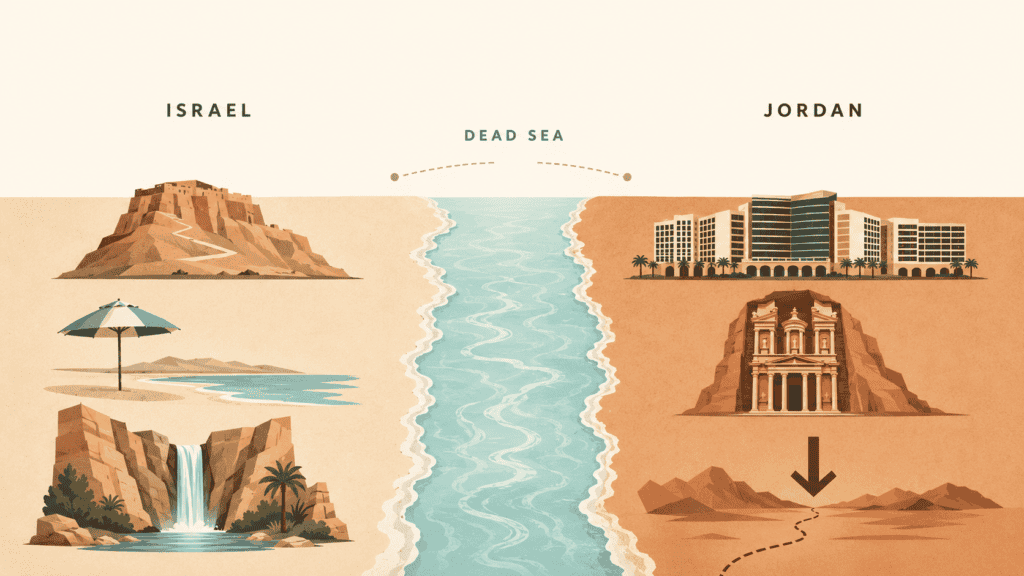
Choose the Dead Sea if you want the unusual physical experience of floating in dense brine, a desert landscape, and a visit that can range from a free public beach to a resort stay. Choose Iceland’s Blue Lagoon if you want reliably warm geothermal water, a polished timed-entry spa, and an experience that fits naturally before or after a flight through Keflavik.
Neither is simply a better version of the other. The Dead Sea is a hypersaline lake system shared by Israel and Jordan. The Blue Lagoon is a managed geothermal bathing attraction in Iceland. Their water, setting, booking model, and best use are different enough that the right choice begins with the trip you are already planning.
The quick decision
| If your priority is | Better fit | Why |
|---|---|---|
| A float you cannot reproduce in ordinary seawater | Dead Sea | Dense brine supports the body strongly at the surface |
| Warm outdoor bathing in cold weather | Blue Lagoon | The geothermal water is maintained around bathing temperature |
| A flexible public-beach visit | Dead Sea in Israel | Managed public beaches in the southern hotel district do not use timed admission |
| A packaged spa with locker, towel, mask, and drink | Blue Lagoon | These are built into its admission products |
| Desert history and nature in the same region | Dead Sea | Masada, Ein Gedi, Qumran, and Jordanian sites can shape the wider route |
| A short stop near an international airport | Blue Lagoon | It sits on Iceland’s Reykjanes Peninsula near Keflavik Airport |
| A medically supervised skin program | It depends | Compare the exact treatment, diagnosis, evidence, and clinical oversight, not the destination name |
If the Dead Sea is new to you, start with the first-time visitor guide and the explanation of why people float.
Best fit: The Dead Sea wins for buoyant floating; the Blue Lagoon wins for warm, scheduled spa bathing.
What the water actually is
The Dead Sea is naturally concentrated chloride brine. A Geological Survey of Israel analysis measured salinity near 340 grams per litre and density near 1.24 kilograms per litre in 2011. Those are dated measurements from a changing lake, not a permanent specification for every beach, depth, or evaporation pond. The major dissolved components include chloride salts associated with magnesium, sodium, calcium, and potassium.
That concentration creates the famous buoyancy. You enter slowly, sit back, and let the brine support you. This is not conventional swimming, and the Dead Sea salinity guide explains why the experience differs from an ocean beach.
The Blue Lagoon describes its water as geothermal seawater made from about 70 percent ocean water and 30 percent freshwater. Heat and pressure below the Reykjanes Peninsula bring the water into contact with volcanic rock, and the resulting bathing water contains silica, algae, and minerals. Its pale colour is associated with suspended silica, while the surface water is kept warm enough for soaking throughout the year.
The difference is simple to feel. At the Dead Sea, concentration changes how your body floats. At the Blue Lagoon, geothermal heat changes how long and comfortably you can soak in cool Icelandic weather.
What a visit feels like
At the Dead Sea
A Dead Sea visit is usually built around a managed beach or hotel shore. You change, enter carefully, recline face-up, rinse, and spend much of the visit on land. Mud is not guaranteed at every access point, so do not assume that a beach ticket or hotel stay includes natural mud.
The setting depends on the shore. Israel’s Ein Bokek and Hamei Zohar hotel district faces the managed southern pond system. Jordan’s main resort area near Sweimeh faces the natural northern lake. Both offer a highly saline floating experience, but they are not one identical measured water sample.
Use the Israel beach guide or the Jordan beach guide before choosing a country, access point, or hotel.
At the Blue Lagoon
The Blue Lagoon is a bookable spa attraction. Admission is tied to a date and arrival time, and the standard experience includes changing facilities, a locker, towel, silica mask, and a drink. Visitors usually plan several hours rather than a brief float.
The water is shallow enough for standing in much of the lagoon, and the emphasis is on soaking, moving between experience areas, and using the mask bar or other booked treatments. It does not provide the same automatic buoyancy as Dead Sea brine.
Cost and booking are not a fair one-number comparison
Blue Lagoon admission uses dynamic pricing. Its own booking page should control the price for your exact date, party, and package. Pre-booking is essential, and a starting price seen months earlier is not a dependable travel budget.
The Dead Sea has several cost models. On Israel’s southern shore, declared public beaches can be free to enter, while parking, equipment, food, transport, or hotel facilities may cost extra. Resort day access and overnight stays have their own inclusions. On Jordan’s shore, visitors can compare the renewed public-beach option with hotel day access and overnight resorts through the Jordan day-pass guide.
For a fair budget, compare the complete day: transport, admission, locker or towel, food, parking, and any resort or spa use. A free beach and a full spa package are not equivalent products.
Which has stronger skin evidence?
There is no responsible single score for this question. Studies at both destinations test specific interventions, and many are not studies of an ordinary tourist visit.
Dead Sea evidence includes controlled research on one prepared 5 percent magnesium-rich salt solution and studies of structured climatotherapy. Those programs can combine bathing, individually dosed ultraviolet exposure, climate, and clinical supervision. A positive result from that package does not prove that a casual float, mud application, or retail product treats a skin disease.
Blue Lagoon research includes a randomized psoriasis trial in which geothermal seawater bathing was combined with narrowband ultraviolet B treatment and compared with ultraviolet treatment alone. Other work has examined Blue Lagoon algae or silica formulations. These findings should not be converted into a promise that general admission provides medical treatment.
The defensible comparison is therefore about the exact intervention. If you are considering either destination for psoriasis, eczema, or another diagnosed condition, read the Dead Sea minerals evidence guide and discuss the actual protocol with a qualified clinician.
Safety differences that matter
Dead Sea brine can sting cuts, eyes, and the mouth. Enter at a declared managed beach, stay face-up, do not dive or splash, and follow the lifeguard’s current instructions. There is no universal session time that overrides local rules or individual ability. Review the Dead Sea swimming rules before entering.
At the Blue Lagoon, heat is the more obvious exposure. Follow the operator’s current guidance, take breaks, stay hydrated, and seek individual medical advice if heat, pregnancy, heart disease, blood-pressure problems, medication, or mobility affects bathing suitability.
Neither destination should be sold as risk-free because it is associated with wellness.
Which trip is easier to build?
Choose the Dead Sea inside the country you are already visiting. In Israel, combine a float with an Israel route using the Jerusalem to Dead Sea guide or the Israel planning hub. In Jordan, keep hotels, beaches, transport, and attractions inside the Jordan planning guide.
Choose the Blue Lagoon inside an Iceland itinerary, especially when the Reykjanes Peninsula and Keflavik Airport already fit the route. Volcanic conditions can affect access, so check the attraction’s current operations and Icelandic official notices before travelling.
The verdict by traveller type
- First-time novelty seeker: choose the Dead Sea for the float itself.
- Cold-weather spa traveller: choose the Blue Lagoon for warm geothermal soaking.
- Budget-conscious independent traveller in Israel: compare the managed public beaches around Ein Bokek and Hamei Zohar.
- Resort traveller in Jordan: compare public access, a day pass, and an overnight stay before paying for more facilities than you need.
- Traveller with a skin condition: choose a named, clinically supervised program only after medical advice. Ordinary admission is not therapy.
- Photographer: choose between desert basin light and black volcanic terrain. Both are visually distinctive, but their days feel completely different.
Only if: Choose either destination for a skin goal only after matching a named program and its evidence to your needs.
Frequently asked questions
Can you float in the Blue Lagoon like the Dead Sea?
Not in the same way. The Blue Lagoon is designed for warm soaking and standing in geothermal seawater. Dead Sea brine is far more concentrated and dense, which supports the body unusually high at the surface. At the Dead Sea, float face-up rather than trying normal swimming strokes.
Is the Dead Sea cheaper than the Blue Lagoon?
It can be, especially when you use a free public beach in Israel, but that comparison excludes transport and paid facilities. Blue Lagoon admission is a packaged, timed spa product with dynamic pricing. Compare the full day and the inclusions for your exact date.
Which is better in winter?
The Blue Lagoon offers reliably warm geothermal water. A Dead Sea visit can still work in winter, but comfort depends on air temperature, wind, beach operations, and how you feel after leaving the water. Check the Dead Sea weather guide and water-temperature guide for the current plan.
Which is better for psoriasis?
Do not choose from a destination headline. Both evidence bases include combined or controlled interventions that differ from casual bathing. Ask a clinician to compare the exact program, ultraviolet exposure, treatment schedule, diagnosis, medication, and evidence that applies to you.
Do both require advance booking?
The Blue Lagoon says pre-booking is essential. Dead Sea public beaches generally do not use the same timed-admission model, but hotels, day passes, attractions, transport, and some nature sites may require reservations. Confirm every paid or capacity-limited part of the day.
Medical note: This article is for general information and does not constitute medical advice. A spa visit, mineral bath, float, mud application, or cosmetic product is not a substitute for diagnosis or treatment by a qualified healthcare professional.