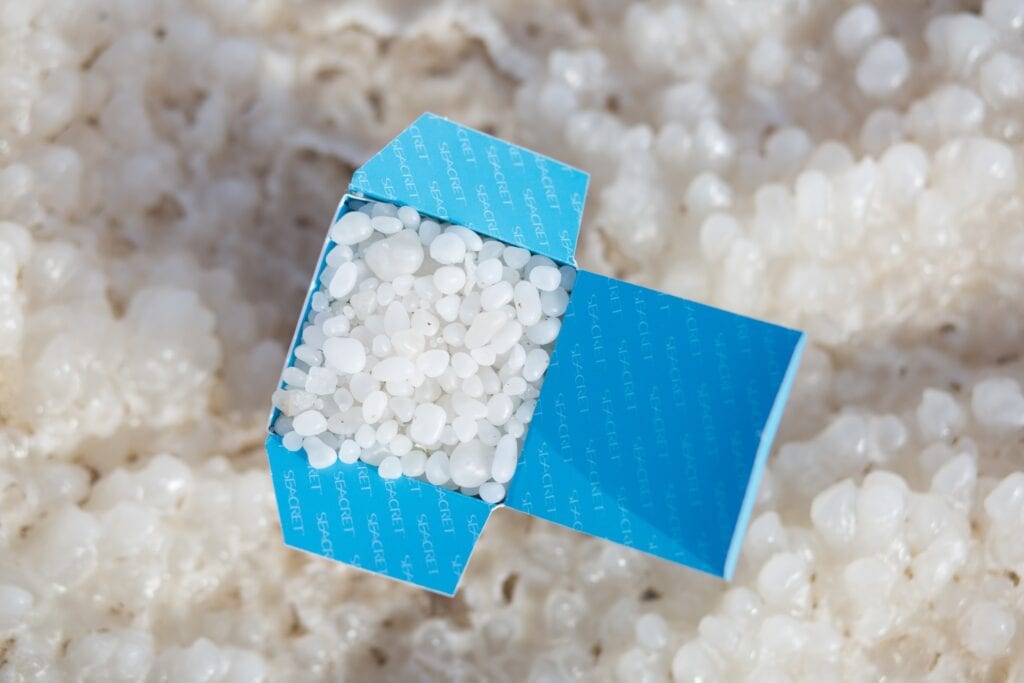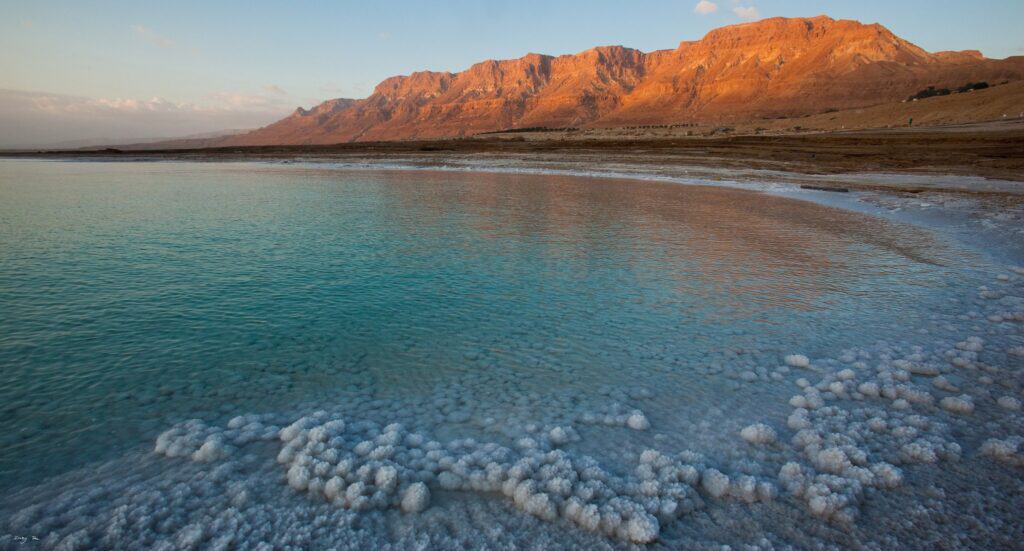
Dead Sea brine has a distinctive mineral composition, but the word minerals does not prove a health benefit by itself. Research supports several narrower conclusions: one controlled study found skin-barrier improvements from a specific 5 percent magnesium-rich Dead Sea salt solution, and structured Dead Sea climatotherapy has produced short-term improvement in selected patients. Neither finding applies automatically to a casual float or every retail product.
Start with the Dead Sea salinity guide if you want the chemistry before the clinical evidence.
What minerals are in Dead Sea water?
Dead Sea water is a chloride brine. A Geological Survey of Israel analysis reported salinity near 340 grams per litre and density near 1.24 kilograms per litre in 2011. Those values are dated measurements, not permanent specifications for every place and depth; the major dissolved components include chloride salts associated with magnesium, sodium, calcium, and potassium.
Bromide and smaller amounts of other elements are also present. The balance differs substantially from ordinary seawater, which is why Dead Sea versus ocean water is more useful than calling the lake simply saltier.
| Component | What is established | What is not established |
|---|---|---|
| Magnesium | It is abundant in the brine and prominent in a studied 5 percent salt solution | That magnesium alone explains every clinical outcome |
| Sodium | It is part of the concentrated salt mixture | That more sodium produces a skincare benefit |
| Calcium | It is a major brine component | That bathing delivers a proven calcium treatment to the skin |
| Potassium | It is present in the brine | That environmental exposure produces a specific moisturizing effect |
| Bromide | It is present at a higher proportion than in ordinary seawater | That a float has a sedative or calming drug effect |
Brine chemistry and clinical benefit are two different questions. A laboratory can measure which ions are present. A health claim requires a suitable human study of the exact exposure, population, comparison, and outcome. Moving from “contains magnesium” to “treats inflammation” skips most of the evidence chain.
The Dead Sea facts guide provides the physical context, while why people float explains what density changes in the water.
The strongest salt-bath study is narrower than the headline
A 2005 controlled clinical study asked volunteers with atopic dry skin to immerse one forearm in a 5 percent solution made with one magnesium-rich Dead Sea salt and the other forearm in tap water during the same trial. The study followed skin-barrier water loss, hydration, roughness, and redness over six weeks.
The salt-treated arm showed better hydration, reduced roughness and redness, and improved barrier function in the subgroup that began with elevated water loss. The authors considered the high magnesium content a likely contributor.
What this controlled study can and cannot answer
Using each volunteer’s tap-water forearm as the control makes the comparison stronger because the two forearms belonged to the same person, but it does not turn the trial into proof for every form of eczema or every product. It was a comparison, not a travel prescription. The protocol used a 15-minute forearm immersion in a prepared 5 percent solution, a different exposure from natural Dead Sea brine. For a visitor, the study supports one careful conclusion: repeated exposure to that specific solution improved selected skin-barrier measures, while the same evidence provides no safe recipe for mixing salts, treating an active flare, or replacing clinical care.
This result matters, but its boundaries matter just as much:
- It studied one salt preparation and one 5 percent solution.
- It treated forearms, not the whole body.
- It involved volunteers with atopic dry skin, not every skin type, diagnosis, active flare, or person.
- It does not cover every retail salt.
- It does not isolate magnesium from the study solution.
The Dead Sea salt benefits guide can expand this one exposure without transferring it to unrelated products.
Climatotherapy is a combined medical program
Dead Sea climatotherapy combines controlled sun exposure, bathing, the local climate, and clinical planning over days or weeks. Research on that package cannot identify every improvement as a mineral effect.
Psoriasis has the best-developed Dead Sea evidence. A 2012 systematic review found support for Dead Sea treatment, but the studies varied in design and included several combined exposures. A 2020 prospective cohort followed 18 patients through an individualized four-week program and reported a large average short-term reduction in psoriasis severity. [1] Visible symptoms returned after treatment, and the study did not find long-term disease control; a related 2022 study found that inflammatory skin markers fell after the program and returned toward baseline at relapse. [2] That reinforces the short-term finding while showing why clearance should not be described as a cure.
What short-term improvement means
In the 2020 cohort, 18 patients completed an individualized four-week program, and the mean Psoriasis Area and Severity Index fell by 13 points, an 88 percent reduction from baseline during the observed treatment period in that small group. That result is large. Visible symptoms returned a mean 93.8 days after treatment ended, with individual observations ranging from 31 to 219 days among the reported participants. [1] The cohort had no untreated comparison group, so it shows what happened during and after one structured program without proving that the same result will occur after a beach visit, a salt bath, or a cosmetic.
A four-week individualized program is not equivalent to one beach visit. It combines exposure schedule, sun, bathing, clinical selection, and monitoring. When several elements change together, the study may support the program, but it cannot honestly assign the full result to magnesium, mud, elevation, or sunshine alone.
The Dead Sea health guide separates structured treatment research from ordinary tourism; the Ein Bokek guide covers the visitor area without presenting a public beach as a clinic.
What does research say about atopic dermatitis?
The 2005 forearm study examined atopic dry skin and a specific salt solution. A separate 2012 prospective study followed 49 adults with atopic dermatitis during a computer-designed Dead Sea climatotherapy program that gradually increased sun exposure after bathing. Skin severity and quality-of-life scores improved during the program.
That was a combined intervention without a parallel untreated group described in the abstract. It therefore cannot prove that Dead Sea minerals alone caused the change or that a person should reproduce the schedule independently.
Indoor balneophototherapy research adds another boundary. A 2020 abridged Cochrane review of salt-bath plus ultraviolet B treatment for chronic plaque psoriasis found possible benefit over ultraviolet B alone, but rated the evidence low certainty and based the conclusion on a limited number of trials. This is supervised treatment research, not a home-bath recipe.
Where elevation and climate fit
The Dead Sea’s low elevation changes the environment in which treatment programs operate. Measurements show that the long atmospheric path attenuates some ultraviolet B wavelengths more strongly than at higher locations. Ultraviolet A and ultraviolet B are still present, and neither low elevation nor haze prevents sunburn or cumulative skin damage.
This matters because a climatotherapy outcome cannot be rewritten as a mineral-only outcome; the program may include a planned ultraviolet dose, gradual exposure, bathing, rest, and clinical assessment. Removing the medical schedule while keeping only sun and salt changes the intervention.
Why the ultraviolet setting still needs planning
A 25-year measurement review found that ultraviolet B was attenuated more than ultraviolet A at the Dead Sea, with the shorter ultraviolet B wavelengths reduced more strongly than the longer wavelengths used there in psoriasis protocols. Ultraviolet exposure remains real. The review used month and hour of day to shape individualized exposure intervals, which shows why an unsupervised visitor should not borrow a clinical schedule. The useful travel decision is to separate a treatment program from ordinary sightseeing: low elevation changes the spectrum, but it does not remove sunburn, photoaging, precancerous skin change, or skin cancer risk from prolonged exposure.
The Dead Sea elevation guide explains the physical measurement. The water level guide keeps today’s falling surface separate from atmospheric effects, and the Dead Sea environment guide covers the wider basin. None of those physical facts provides a personal treatment prescription.
What about arthritis and pain?
Arthritis has also been studied. The older literature contains small controlled trials and mixed treatment packages. A 2026 systematic review found consistent short-term improvements across nine studies, but only two could be pooled for pain, and that pooled result was statistically inconclusive; the authors emphasized heterogeneity and the need for stronger trials.
What the 2026 review adds
The 2026 review included 10 articles representing nine studies and 465 adults, across conditions and intervention formats that were too different for one broad pooled answer. That is the main limitation. Only two studies could be pooled for pain, and that result was statistically inconclusive; the review also noted inconsistent safety assessment, so the absence of reported serious adverse events cannot become a blanket safety promise for every traveler or patient.
The useful conclusion is modest: selected programs may help some short-term outcomes, but the evidence does not justify a universal pain-relief promise for a float, mud application, hotel spa, or cosmetic.
If pain or mobility is part of the trip, use the Dead Sea accessibility guide for the physical plan and ask a qualified clinician about medical suitability.
Does Dead Sea mud have proven benefits?
Mud is a formulation, not one constant ingredient. Mineral source, particle size, processing, preservatives, fragrance, and contact time can all differ between natural sediment and a finished mask.
A four-week study of three Dead Sea mud formulations on healthy skin found that effects varied by formulation. That supports product-specific testing, not a universal mud treatment claim. It also does not justify collecting shoreline mud from an unmanaged area, where access may be unsafe and the material is not a controlled cosmetic product.
What the mud study actually measured
In the four-week mud study, healthy volunteers applied three formulations to their forearms every other day: mud as supplied, mud with extra Dead Sea salt, and an over-the-counter mud product; researchers measured hydration, water loss, pH, redness, elasticity, thickness, and collagen at set intervals. This was healthy skin. Overall hydration did not change significantly, although the formulations showed small differences, including slight drying with two muds and slight hydration with the retail product. The study found no noticeable change in several barrier and color measures and did not test disease treatment, which makes it useful for comparing formulations but inadequate for claiming that all Dead Sea mud moisturizes, heals, or treats a diagnosed condition.
Use the Dead Sea skincare guide to compare finished product types and where to buy Dead Sea products to check the seller and label.
Can individual minerals be credited with specific effects?
Only within the exposure actually studied. Magnesium is biologically relevant and prominent in Dead Sea brine, but the 2005 study tested a complete salt solution. It did not compare isolated magnesium against calcium, potassium, or bromide.
Claims that calcium repairs the skin, potassium restores natural moisturizing factor, bromide sedates the nervous system, or trace strontium stops itching may borrow mechanisms from other research; they do not become clinical Dead Sea-bathing findings merely because those elements occur in the water.
The same rule applies to absorption. A change measured at the skin surface does not prove that large amounts of minerals entered the bloodstream. Claims about systemic absorption, kidney load from normal bathing, or sealing minerals into skin with a moisturizer need direct evidence for that exact exposure.
The honest benefit statement names the tested package. “A 5 percent solution of one magnesium-rich Dead Sea salt improved several forearm skin measures in a controlled study” is useful. “Thirty-five minerals penetrate the body and treat inflammation” is broader, less precise, and not supported by the same experiment.
What can an ordinary visitor reasonably expect?
Reliable expectations here are physical, not medical. The brine is dense, it supports the body strongly, and concentrated salt can sting the eyes, mouth, and sensitive or broken skin. Individual skin feel after rinsing varies, and a pleasant result is not a diagnosis or treatment outcome.
Use a managed beach, follow its instructions, and keep the water away from the face. There is no universal therapeutic soak time for every visitor. The Dead Sea safety guide and swimming rules explain why local conditions replace a fixed 15 or 20 minute formula.
If water reaches the eye, rinse with plenty of clean, not hot, water for at least 20 minutes. If someone swallows or inhales it, get help now; use the drinking-water guide.
How to evaluate a retail product
Buy the finished formula, not the story printed around it. Check:
- the complete ingredient list
- directions and warnings
- the responsible company or distributor
- batch or lot information
- net contents and durability information where required
- fragrance or ingredients you already avoid
- seller identity and return policy
The word natural does not guarantee lower allergy or irritation risk. A product containing Dead Sea salt or mud also does not reproduce natural brine, a clinical salt bath, or climatotherapy unless its own evidence establishes that comparison.
Use the product buying guide before choosing an online seller; the Dead Sea product hub keeps cosmetics separate from destination planning.
Medical and safety note
This article is for informational purposes only and does not constitute medical advice. Consult a qualified healthcare professional about individual health questions. Structured climatotherapy includes ultraviolet exposure, which can cause sunburn and cumulative skin damage; treatment suitability depends on diagnosis, skin type, medication, health history, and clinical supervision.
For an ordinary visit, check the Dead Sea weather guide, heat safety guide, and first-time visitor guide before entering the water.
Questions visitors ask
What is the main mineral in Dead Sea water?
There is no single mineral that describes the whole brine. Chloride is the dominant anion, with substantial magnesium and sodium plus calcium, potassium, bromide, and other components; the proportions differ from ordinary seawater, and exact concentrations need a sample date, location, depth, and laboratory method used.
Are Dead Sea minerals proven to help psoriasis?
Research supports short-term improvement from structured Dead Sea climatotherapy in selected psoriasis patients. That program combines individualized sun exposure, bathing, climate, and clinical oversight. It does not prove that minerals alone caused the outcome, that one casual float treats psoriasis, or that a retail cream reproduces the program.
Can Dead Sea salt help dry or atopic skin?
One controlled study found improved hydration, roughness, redness, and selected barrier measures after repeated forearm immersion in a specific 5 percent magnesium-rich Dead Sea salt solution. The result is promising but narrow. It should not be transferred to every bath concentration, product, person, or active eczema flare.
How long should I soak for health benefits?
There is no universal therapeutic duration for an ordinary Dead Sea visit. Research protocols used specific products, populations, schedules, and supervision, while the active beach rules and conditions can also vary by location and day. Follow the active beach rule and your clinician’s advice, then leave immediately if you feel unwell or cannot control your position.
Does the body absorb Dead Sea minerals through the skin?
Some ions interact with the skin surface, and studies can measure hydration or barrier outcomes. That does not prove large systemic absorption or a whole-body mineral treatment. Any claim about blood levels, kidney effects, or a specific absorbed dose needs direct evidence from that exposure rather than a mechanism alone.
Is Dead Sea mud a treatment?
Do not treat every mud product as a medicine. Research on mud is formulation-specific, and finished masks can differ in minerals, processing, preservatives, and fragrance. Follow the product label, stop if irritation occurs, and ask a clinician before using it on a diagnosed condition or compromised skin.
Are Dead Sea cosmetics the same as bathing in the lake?
No. A cosmetic is a finished formula with its own ingredient list and directions; natural brine, a 5 percent study solution, mud, hotel spa treatments, and four-week climatotherapy are different exposures. Evidence for one should not be copied to another without a direct comparison.
Is a Dead Sea visit safe during pregnancy or with a medical condition?
This page cannot determine individual suitability. Pregnancy, heart or kidney disease, active skin disease, medicines, heat sensitivity, and mobility needs may change the plan; ask a qualified clinician who knows your history, then follow the current beach, weather, and emergency instructions for the chosen shore.
Sources for the climatotherapy studies
- Emmanuel T, Lybæk D, Johansen C, Iversen L. Effect of Dead Sea Climatotherapy on Psoriasis; A Prospective Cohort Study. Frontiers in Medicine. 2020;7:83. DOI: 10.3389/fmed.2020.00083.
- Emmanuel T, Petersen A, Houborg HI, et al. Climatotherapy at the Dead Sea for psoriasis is a highly effective anti-inflammatory treatment in the short term: An immunohistochemical study. Experimental Dermatology. 2022;31(8):1136-1144. DOI: 10.1111/exd.14549.