By DeadSea.com Editorial
Last reviewed: September 2026
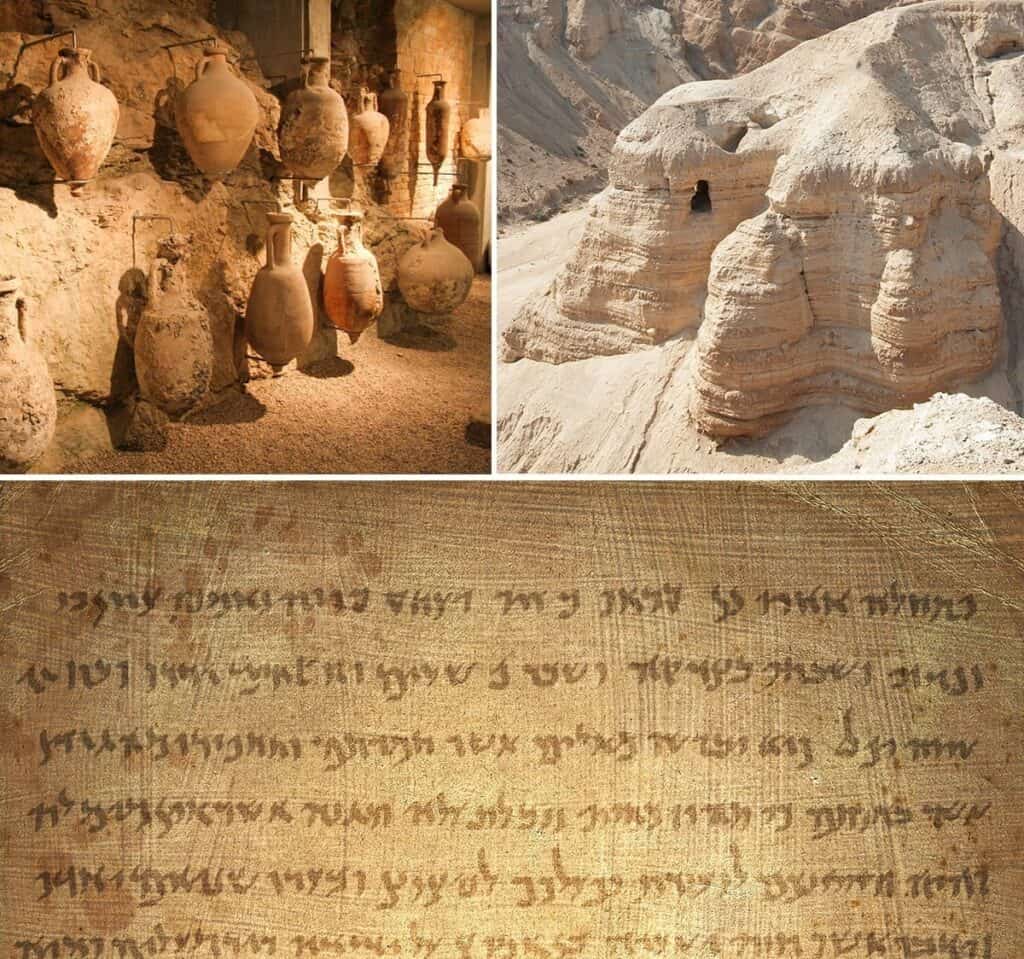
The War Scroll is an ancient Jewish manuscript that imagines a final conflict between the Sons of Light and the Sons of Darkness. Catalogued as 1QM, it was among the first seven Dead Sea Scrolls recovered from Cave 1 near Qumran in 1947 and now survives in 19 Hebrew columns on a parchment roll about 2.79 metres long, with at least one further column probably lost.
The text is extraordinary because it moves between battlefield instructions and worship. It assigns formations, signals and roles to the human army, then frames the campaign as part of a cosmic struggle involving God, angels and Belial; it is a literary plan for an expected future battle, not a report that historians can place on a conventional military timeline.
What does the War Scroll contain?
The manuscript presents the Sons of Light as a covenant community joined by forces associated with Levi, Judah and Benjamin; their opponents include Belial, the Kittim and named enemies such as Edom, Moab, Ammon and Philistia. The Israel Museum’s catalogue cautiously glosses the Kittim as “Romans?” because that identification is widely discussed but still interpretive.
In the climactic seven-part battle, the Sons of Light prevail three times and the Sons of Darkness three times; God decides the seventh engagement. This sequence belongs to the scroll’s idealised design, not to an independently recorded series of battles.
There is plenty of practical detail. The scroll describes battle formations, trumpets, banners, weapons and the ages assigned to different duties. Men aged 25 to 30 receive camp-support roles, while men aged 40 to 50 are assigned to the fighting force. Priests deliver prayers and speeches before and during combat.
The War Scroll does not simply predict who wins. It imagines how a faithful army would be organised, what its trumpets and banners would proclaim, and how priests would interpret each stage of battle. Military order and religious meaning occupy the same parchment.
Readers who want the wider archaeological setting can start with the Qumran visitor guide and the overview of the Essenes and the scrolls. The relationship between the Qumran manuscripts and a particular community remains a subject of scholarship, so it is better to treat “the Qumran community” as a useful context, not a settled author’s name.
Was the war meant to last 40 or 49 years?
Both numbers appear in reputable summaries because they count the schedule differently. The Israel Museum describes a 49-year confrontation. Encyclopaedia Judaica describes 40 years of warfare, with sabbatical years free from fighting. Another scholarly summary separates periods of combat from preparation and rest.
So the safest short answer is this: the manuscript lays out a long, staged campaign governed by a sevenfold pattern. “Forty years” can describe the fighting years, while “49 years” can describe the broader confrontation; presenting either number without that context makes the sources look more contradictory than they are.
The familiar 40-year and 49-year figures are not interchangeable totals. One counts years of warfare, while the other describes the larger seven-cycle framework. The distinction matters because rest, preparation and sabbatical intervals are part of the scroll’s imagined order overall.
Is it a Roman military handbook?
No. Some formations, equipment and manoeuvres recall Hellenistic and Roman military manuals, and the possible identification of the Kittim with Rome gives that comparison added force; Yigael Yadin’s major 1962 study helped shape that comparison by drawing attention to formations, cavalry, staged attacks and trumpet signalling. Yet the scroll is not a neutral field guide.
The combination is the point. It shows how the writer turned recognisable military practices into a theological vision, but it does not prove that the group possessed a working army or fought the campaign it describes.
The manuscript is generally dated to the late first century BCE or early first century CE. That range is more accurate than assigning it only to the late first century BCE. For a broader historical frame, see the history of the Dead Sea Scrolls and the guide to where the scrolls can be seen.
Why is the War Scroll important?
The scroll gives readers an unusually detailed view of apocalyptic expectation in ancient Judaism. Its world is sharply divided, but its description of battle is not simple fantasy. The writer gives attention to age groups, formations, trumpet calls and inscriptions, as though ideal order on earth should reflect an already decided order in heaven.
It also resists an easy label. The Israel Museum notes that the work has an idealised or fictional quality, yet it is not a standard apocalypse: no messianic figure dominates the account. Michael, the Prince of Light, and Belial belong to its cosmic framework, while human priests and soldiers carry out the prescribed actions.
That mix makes 1QM useful for comparison with the Masada history guide, which deals with a documented Roman-period conflict rather than an imagined final war.
The Dead Sea historical timeline provides the wider chronology for both subjects.
Can you visit the discovery site or see the manuscript?
Qumran is the archaeological site associated with Cave 1 and the wider scroll discoveries; it belongs in a northern Dead Sea itinerary, but opening conditions and ticket arrangements can change. Use the Qumran and Dead Sea Scrolls guide to plan the site visit.
The War Scroll is held in the Israel Museum collection. A museum visit and a Qumran visit answer different questions: the museum provides access to manuscripts and interpretation, while Qumran provides the physical landscape and archaeological context. Do not assume that a particular original manuscript is on display on the day of your visit; exhibitions can rotate.
Frequently asked questions
Who are the Sons of Light and Sons of Darkness?
The Sons of Light are the faithful forces in the manuscript’s covenantal framework, while their opponents include Belial, hostile nations and the Kittim, a name often associated with Rome. These are the text’s theological and literary categories, not modern groups or a complete list of historical armies.
Where was the War Scroll found?
The main manuscript, catalogued as 1QM, came from Cave 1 near Qumran and was one of the first seven Dead Sea Scrolls recovered in 1947. Other fragments related to a “War Rule” exist, but they should not automatically be treated as pieces of this exact roll.
How old is the War Scroll?
The manuscript is generally dated from late in the first century BCE to early in the Common Era, a scholarly dating range rather than the date of a battle. The roll preserves at least 19 columns and probably had at least one additional column originally.
Did the war described in the scroll really happen?
There is no basis for reading the War Scroll as a chronicle of a completed 40-year or 49-year campaign. It is an idealised vision of a future confrontation. Familiar tactics and enemies give it historical texture, but divine intervention and cosmic opposition govern the narrative.
Is the War Scroll the same as all the Dead Sea Scrolls?
No. The Dead Sea Scrolls form a large collection of biblical manuscripts, interpretations, community texts, prayers and other works, while the War Scroll is one distinctive composition whose military detail should not be used to characterise every text recovered around Qumran.