By DeadSea.com Editorial
Last reviewed: September 2026
Many scholars connect the community that lived at Qumran with the Essenes described by Josephus, Philo, and Pliny the Elder. The theory fits several pieces of evidence, including geography, communal practices, ritual installations, and sectarian texts found in nearby caves. It does not prove that every resident was an Essene or that one group wrote every manuscript.
The most accurate short answer is therefore qualified: an Essene connection remains a leading explanation for Qumran and part of the Dead Sea Scrolls collection, while the site’s identity, the library’s formation, and the authorship of individual works continue to be debated.
Qumran, the Essenes, and the scrolls overlap strongly in the leading scholarly model. They are not three interchangeable names for the same thing.
Who were the Essenes?
Ancient authors describe the Essenes as a Jewish movement with disciplined community rules, shared property, ritual practices, study, and distinctive approaches to daily life. Their accounts differ in emphasis. Josephus describes a wider movement numbering in the thousands, and he notes more than one pattern of marriage. Pliny places an Essene community on the western side of the Dead Sea, north of Ein Gedi.
That geography helped later scholars associate the descriptions with Qumran. Pliny does not name the archaeological site, and the ancient writers do not mention the cave manuscripts. Their testimony is one evidence strand, not a label found on the ruins.
The Dead Sea historical timeline places the community in its wider period.
The main Dead Sea history guide connects that period with the region’s other major sites and sources.
What was found at Qumran?
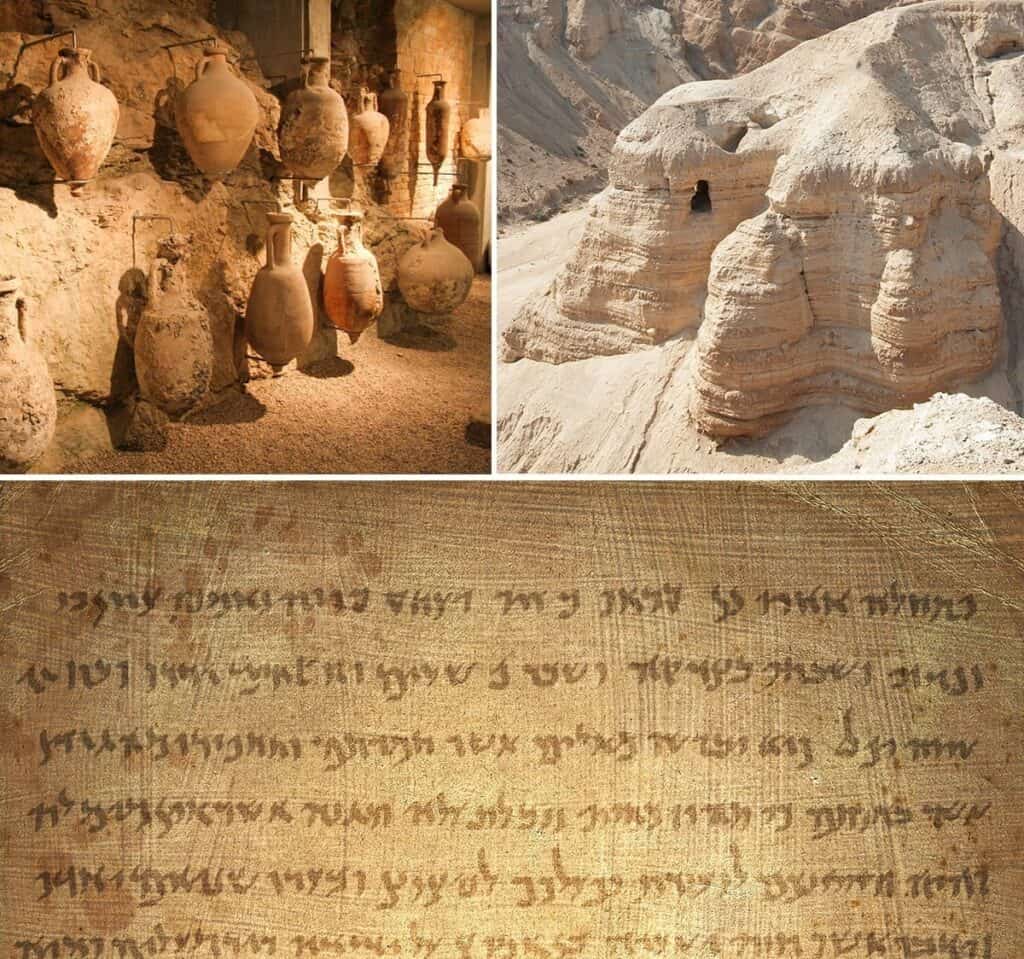
Excavations revealed a settlement with water installations, rooms used for communal activity, pottery, writing equipment, and a large nearby cemetery. The site developed during the late Second Temple period and was abandoned around the time of the First Jewish Revolt.
Some installations have been interpreted as ritual immersion pools. A room with inkwells and furniture fragments became known as a scriptorium. Those finds make literary activity plausible, but a modern room label cannot tell us who wrote a particular scroll.
The archaeological site and the caves also need to remain distinct. Manuscripts were found in caves around Qumran, not neatly shelved inside the settlement. The relationship between the settlement, the people using the caves, and the full library is the central question.
What do the scrolls say about a community?
Several texts describe a tightly organized group. The Community Rule presents admission stages, shared discipline, communal meals, ranking, and penalties. Other sectarian works discuss calendars, purity, law, biblical interpretation, and an expected conflict between the Sons of Light and the Sons of Darkness.
These writings do not call their group “the Essenes.” Terms such as Yahad, meaning community, appear within the texts. Similarities with ancient descriptions helped build the Essene theory, while differences and gaps prevent a simple one-to-one identification.
The War Scroll guide examines one apocalyptic composition.
The guide to whether the scrolls are Old or New Testament explains how sectarian works fit beside biblical manuscripts and other Jewish texts.
The scrolls preserve a community’s own rules and arguments, while Josephus, Philo, and Pliny describe Essenes from outside. The identification depends on comparing those records.
Did the Essenes write all the Dead Sea Scrolls?
No responsible account should assign the whole collection to one authoring group. The library contains biblical manuscripts, works already circulating in Jewish communities, prayers, legal texts, commentaries, apocalyptic compositions, and writings that appear closely connected to a sectarian community.
Even within an Essene model, a community could collect, copy, study, and preserve works it did not compose. Manuscripts also differ in date, scribal style, language, and purpose. The Dead Sea Scrolls explained page introduces that diversity.
Alternative theories give more weight to Jerusalem libraries, multiple groups, or a broader regional manuscript culture. The Israel Antiquities Authority notes that the earlier practice of assigning all the scrolls to Essenes has been challenged and modified. Many scholars still maintain a meaningful link.
Why did a group live in the desert?
Sectarian texts reveal sharp disagreements about law, calendar, purity, leadership, and Temple practice. A community could use separation to organize life around its own rules and prepare for the future it expected.
The desert was not empty. Roads, farms, fortresses, oases, and settlements existed around the lake. Qumran’s location offered access to water systems and routes while remaining outside Jerusalem. Describing its residents as entirely cut off from the world would be misleading.
The Dead Sea in the Bible provides the earlier textual landscape.
The page on King Herod and the Dead Sea introduces the political and architectural world in which the settlement developed.
What happened to Qumran and the library?
Qumran was abandoned around the First Jewish Revolt, when Roman forces were moving through the region. It is possible that manuscripts were placed in caves for protection during that crisis. The evidence does not establish that one Essene community sealed the entire collection in a single coordinated act.
The first scrolls reached public and scholarly attention after Bedouin discoveries beginning in 1947. Further searches and excavations expanded the collection across eleven caves near Qumran. The dry cave environment helped preserve parchment and papyrus that would usually have disappeared.
Were the Essenes connected to early Christianity?
The Essenes, the Qumran movement, John the Baptist, and the earliest followers of Jesus all belong to the diverse Jewish world of the late Second Temple period. Comparisons often focus on immersion, communal organization, messianic expectation, scriptural interpretation, and life in the wilderness.
Similarity does not prove membership or direct influence. The scrolls do not identify Jesus or John the Baptist as community members, and no accepted New Testament manuscript was found among them. The comparison is historically useful when those limits remain visible.
Visiting Qumran today
Qumran National Park presents the settlement, water installations, displays, and views toward nearby caves. The caves themselves are not a walk-in manuscript exhibit. Site signs and the visitor centre help connect the ruins with the discovery story.
Check the official park surface through the attraction guide before travel because hours, fees, reservations, and route conditions can change. The historical question is worth carrying through the site: which features identify a community, and which interpretations depend on texts found beyond the walls?
Frequently asked questions
Were the people at Qumran Essenes?
Many scholars think an Essene or Essene-related community lived there, based on ancient descriptions, geography, archaeology, and sectarian texts. Other scholars dispute or modify that identification. No inscription at the site simply names its residents as Essenes.
The conclusion is persuasive to many researchers, while remaining an interpretation.
Did the Essenes write the Dead Sea Scrolls?
They may have composed, copied, collected, or preserved part of the library if the leading Qumran-Essene theory is correct. The collection is too diverse to describe as the work of one community, and authorship differs from ownership or preservation.
What did the Essenes believe?
Ancient descriptions and sectarian texts point to strict communal discipline, ritual practice, study, distinctive legal interpretation, and strong expectations about divine judgment. Specific beliefs differed across sources and may not describe every Essene group in the same way.
The evidence is strongest when each source keeps its own scope.
Were the Essenes early Christians?
No. They were part of Jewish religious life before and during the first century CE. Scholars compare some practices and expectations with early Christianity, but similarity does not make the communities identical or prove direct membership links.
No accepted scroll identifies Jesus or John the Baptist as a member.
Can visitors enter the scroll caves?
Qumran National Park provides views, interpretation, and access to the excavated settlement. Visitor access to individual caves is restricted and can change. Use the current attraction page and official park information for permitted routes.
The main public experience is the settlement, displays, and cave views.