Use table salt for food when the product is labelled for culinary use. Use a Dead Sea salt product only for the cosmetic or bathing purpose stated on its label. They share the word “salt,” but they should not be treated as interchangeable ingredients, medicines, or home spa recipes.
Table salt is sodium chloride used as a food ingredient. Dead Sea salt is a variable mixture of mineral salts derived from concentrated brine or processing streams. A bath product should never be eaten simply because both materials form crystals.
The quick comparison
| Question | Dead Sea salt product | Table salt |
|---|---|---|
| Main purpose | Usually bathing, cosmetic, or industrial use, depending on label | Food seasoning and preservation, depending on label |
| Chemistry | Mixture of chloride salts, often including magnesium, sodium, calcium, and potassium | Primarily sodium chloride, sometimes with iodine or anti-caking ingredients |
| Can you cook with it? | Not unless a product is specifically sold and regulated as food | Yes, when labelled as food |
| Can it reproduce the lake? | No | No |
| Does “contains minerals” prove a benefit? | No | No |
| Key buying check | Ingredients, intended use, directions, warnings, responsible seller | Nutrition label, sodium content, iodine where relevant, intended culinary use |
For the natural-water chemistry, use the Dead Sea salinity guide rather than a product marketing table.
Best fit: Keep food salt in the kitchen and use bath products only as their labels direct.
What table salt is
The U.S. Food and Drug Administration describes table salt by its chemical name, sodium chloride. Sodium and chloride form the familiar crystal used to season and preserve food. Iodized table salt adds a source of iodine, and some products include anti-caking ingredients.
That means “table salt is 100 percent sodium chloride” is not a reliable statement for every retail package. The basic salt is sodium chloride, but the finished food product can contain permitted additions. Read the label.
Table salt also should not be confused with every sea salt or specialty culinary salt. Grain size, moisture, trace components, iodine, and additives can differ, while sodium intake still matters.
What Dead Sea salt is
Dead Sea brine contains abundant chloride with substantial magnesium and sodium plus calcium, potassium, bromide, and other components. A Geological Survey of Israel analysis measured the natural brine, but a harvested or processed retail salt is a different sample.
The solid product can vary by source, crystallization, washing, and processing. That is why the old page’s precise universal percentages were unsafe. One batch cannot define every product sold under the Dead Sea name.
Use Dead Sea minerals: evidence and limits to understand which claims come from chemistry and which require human research.
The Dead Sea salt versus Epsom salt guide covers the separate comparison with magnesium sulfate.
Why you should not swap them in recipes
Dead Sea bath salt is not a gourmet seasoning. A product intended for external use may have a bitter mineral profile, cosmetic additives, processing controls designed for bathing rather than food, and no food label. It may also carry warnings that make ingestion inappropriate.
Table salt is not a substitute for natural Dead Sea brine. Adding sodium chloride to a bathtub does not recreate the lake’s density, ion balance, environment, or supervised clinical protocols. More salt also means more potential for irritation and accidental exposure.
The safe rule is direct: use each product only for its labelled purpose.
Does Dead Sea salt have better skin evidence?
One controlled study found improvements in hydration, roughness, redness, and selected barrier measures after repeated immersion of volunteers’ forearms in a specific 5 percent magnesium-rich Dead Sea salt solution compared with tap water.
That finding belongs to the exact solution and study design. It does not prove that every Dead Sea bath product treats a condition, that a scrub is equivalent to soaking, or that a consumer should calculate a research concentration at home.
It also does not justify the old claims that potassium, bromide, and calcium each delivered a specific clinical effect through ordinary bathing. The study tested a complete solution, not one mineral at a time.
The Dead Sea mud versus salt guide compares product formats without turning them into disease treatments.
Can table salt be used in a bath?
Table salt dissolves in water, but that fact does not establish a skincare benefit or a safe do-it-yourself concentration. A high-salt bath can sting or irritate sensitive or broken skin, and a food label may not include bathing directions.
If you want a bath product, choose one made and labelled for bathing. Check the ingredients, amount, warnings, and body-area instructions. Do not assume a homemade mix is safer because the ingredient came from a kitchen.
What about Himalayan pink salt and sea salt?
They belong to the culinary-salt question when they are sold as food. Colour and trace-mineral stories do not automatically produce a meaningful nutritional or dermatological advantage. The amount of a trace element, its chemical form, serving size, contaminant controls, and intended use all matter.
This page does not need to rank every culinary salt. Its main distinction is functional: food salt belongs in food, and bath or cosmetic salt belongs in the use described on the label.
How to buy Dead Sea salt more carefully
Check:
- the full ingredient list
- whether the product is a bath soak, scrub, or another format
- directions for amount, water volume, contact time, and rinsing
- warnings for eyes, damaged skin, children, or medical conditions
- the responsible company or distributor
- lot or batch information, seal, and storage
- seller identity and return policy
Avoid a seller who relies on “35 minerals” without a composition, claims to cure a disease, or suggests eating an external-use product. The Dead Sea product buying guide explains the label and seller checks.
Use the Dead Sea skincare guide to compare finished cosmetic formats before choosing a scrub, soak, or leave-on formula.
What visitors should know at the shore
The natural floating experience comes from concentrated brine, not from a handful of visible crystals. Enter at a managed beach, keep the water away from the face, do not dive, and follow current lifeguard instructions. Cuts can sting.
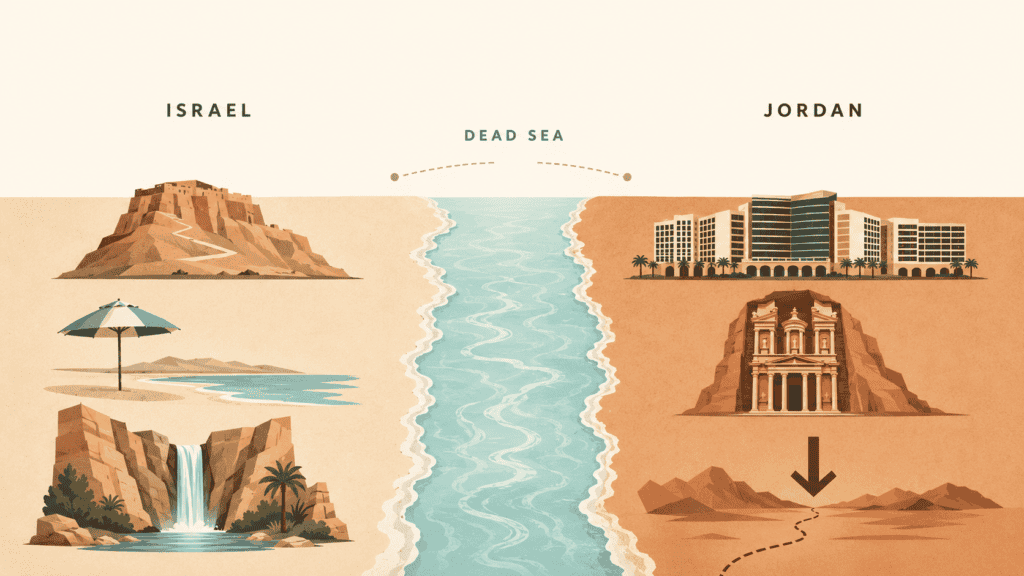
The southern hotel district around Ein Bokek and Hamei Zohar faces managed evaporation ponds, while the natural northern basin has a changing shoreline and sinkhole hazards in some areas. Never walk onto an unmanaged shore to collect salt.
Use the first-time visitor guide, swimming rules, and Israel beach guide or Jordan beach guide before travelling.
Safety rule: Crystal appearance does not make a non-food product edible or a culinary product therapeutic.
Frequently asked questions
Is Dead Sea salt the same as table salt?
No. Table salt is primarily sodium chloride and is sold for food use. Dead Sea salt products contain a different mixture of mineral salts and are usually sold for bathing, cosmetics, or other non-culinary purposes. Read the exact label because their intended uses differ too.
Can you eat Dead Sea salt?
Do not eat a Dead Sea cosmetic or bath product. It may not be produced, tested, labelled, or regulated as food. Use a culinary salt for cooking and follow its nutrition label. Keep bath crystals away from food-storage containers to prevent confusion.
Can table salt recreate a Dead Sea bath?
No. Sodium chloride alone does not reproduce the lake’s ion mixture, density, environment, or research protocols. Adding a large amount to a bathtub can also irritate skin and create an unsafe do-it-yourself exposure. Follow a labelled bath product instead of improvising.
Is Dead Sea salt proven to treat eczema or psoriasis?
One controlled study supports narrow skin-barrier findings for a specific 5 percent magnesium-rich solution in volunteers with atopic dry skin. Structured psoriasis programs involve other components. Neither finding proves that every retail product treats a disease. Discuss a diagnosed condition with a qualified clinician.
How much Dead Sea salt belongs in a bath?
Use only the amount on the product label for the actual water volume. Do not calculate a clinical research concentration from an article, and ask a qualified clinician before using a mineral bath for a diagnosed condition. The water chemistry and your skin tolerance still matter.
Medical note: This article is for general information and does not constitute medical advice. Food salt, bath products, cosmetics, natural brine, and clinical treatment protocols are different exposures.