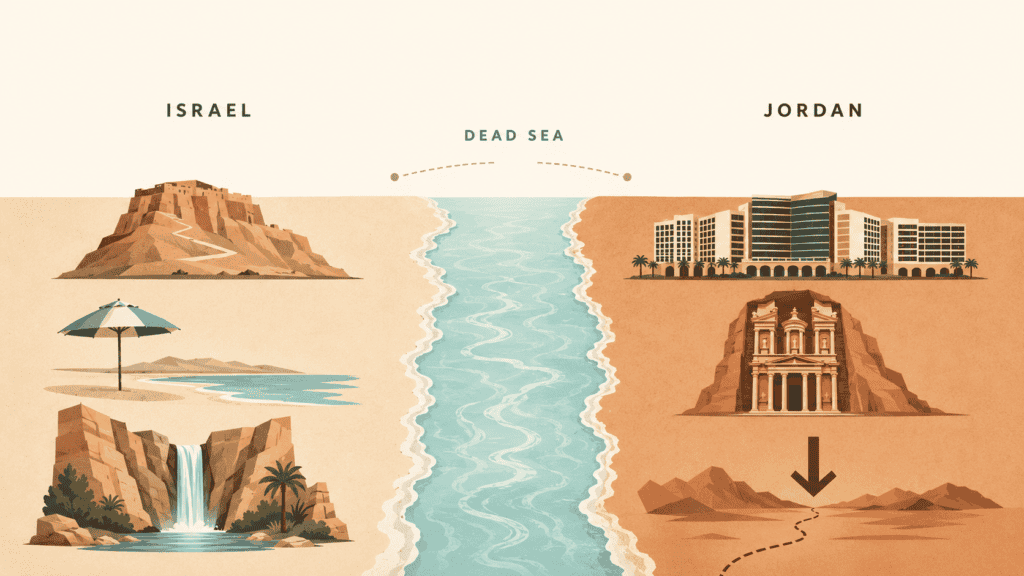
Choose the Dead Sea for a careful face-up float in dense brine, desert scenery, and a short water experience built around a managed access point. Choose the Mediterranean for conventional swimming, waves, marine life, and a longer beach day. In an Israel itinerary, the two can complement each other. In a Jordan itinerary, the Mediterranean is not a domestic beach alternative, so compare the Dead Sea with Aqaba and the Red Sea instead.
This is not a contest between two versions of the same sea. The Dead Sea is a landlocked hypersaline lake system. The Mediterranean is an ocean-connected marine basin.
The quick comparison
| Question | Dead Sea | Mediterranean |
|---|---|---|
| Main activity | Controlled floating | Swimming, wading, paddling, and other marine recreation where permitted |
| Typical salinity | Natural brine measured near 340 grams per litre in a dated study | Average ocean salinity is about 35 parts per thousand, with local variation |
| Body position | Face-up, with strong buoyancy | Normal swimming positions and effort |
| Visible aquatic life | Salt-adapted microorganisms, not fish or reefs in the brine | Diverse fish, plants, invertebrates, and other marine life |
| Water movement | Generally limited wave action at managed shore access | Waves, currents, tides, and changing surf conditions |
| Best trip context | Israel or Jordan Dead Sea itinerary | Israel’s Mediterranean coast or another Mediterranean country |
| Main safety focus | Brine in eyes or mouth, inversion, unmanaged shoreline | Currents, waves, flags, heat, boats, and site-specific marine hazards |
Read Dead Sea versus ocean water for the chemistry before planning the beach day.
Best fit: Choose the Dead Sea to float; choose the Mediterranean to swim.
The water is different by an order of magnitude
The U.S. National Oceanic and Atmospheric Administration gives average ocean salinity as about 35 parts per thousand, or roughly 3.5 percent by weight. Mediterranean salinity varies by place, depth, evaporation, freshwater input, and season, so 3.5 percent should not be treated as the exact value for every beach.
A Geological Survey of Israel report measured Dead Sea brine salinity near 340 grams per litre and density near 1.24 kilograms per litre in 2011. That dated result is far above normal marine water and helps explain the exceptional buoyancy.
The Dead Sea is not simply the Mediterranean with more table salt. Its chloride brine includes substantial magnesium, sodium, calcium, and potassium ions. The Dead Sea salinity guide explains the measured composition without converting it into a universal product formula.
Floating is not swimming
At the Dead Sea, enter slowly at a declared managed beach, sit back, and keep your face above the brine. Ordinary front crawl, diving, splashing, and face-down swimming create avoidable eye, mouth, and position risk. Strong buoyancy does not make every person automatically safe.
At the Mediterranean, ordinary swimming is possible at suitable beaches, but conditions matter. Observe lifeguard instructions, warning flags, waves, currents, watercraft zones, and local rules. A calm-looking shoreline can still have hazards.
Use the Dead Sea swimming rules for the saltwater float. Do not transfer Mediterranean habits to the Dead Sea or Dead Sea handling to an open marine beach.
What lives in each body of water?
The Dead Sea is not sterile. Salt-adapted microorganisms can survive there, and unusual freshwater dilution has been associated with visible microbial blooms. Fish, reef-building corals, and ordinary aquatic plants do not live in the concentrated brine.
The Mediterranean is a biodiversity hotspot. A recent United Nations Environment Programme assessment describes about 17,000 species of fauna and flora across the basin, with uneven distribution and increasing pressure from non-indigenous species and other environmental change. That regional number does not mean every swimming beach contains the same wildlife.
If the biology interests you, continue with what lives in the Dead Sea and why there are no fish.
What a day at the Dead Sea feels like
A Dead Sea day revolves around a managed entry, brief controlled float, freshwater rinse, shade, and the wider desert setting. Mud is not guaranteed at every beach. Hotel pools, spa treatments, towels, food, and lockers depend on the chosen facility or rate.
In Israel, compare the managed beach options and remember that the Ein Bokek and Hamei Zohar hotel district faces managed southern evaporation ponds. In Jordan, keep the plan in the Jordan beach guide and compare public access, day entry, and hotels separately.
Never use an unmanaged shoreline because it looks more natural. Retreating water and sinkholes have made some areas unstable or inaccessible.
What a Mediterranean beach day feels like
The Mediterranean supports a conventional beach day: swimming, wading, playing in waves, walking a coastal promenade, and staying in the water longer when conditions and ability allow. Facilities vary from an urban beach to a quiet reserve or resort.
For an Israel itinerary, choose the exact coastal city and beach according to transport, lifeguard season, accessibility, family needs, and surf conditions. The Dead Sea is inland and requires a separate route. Do not describe the two as an 80-kilometre hop without naming actual endpoints, because road distance and time depend on the beach and departure point.
For a Jordan itinerary, the country has no Mediterranean coast. Use the Dead Sea versus Red Sea guide if you want a domestic Jordan water comparison.
Which is better for children?
There is no universal answer. A Mediterranean beach may feel more familiar to a confident swimmer, but waves and currents need close supervision. Dead Sea brine requires strict face-out handling and can be very painful in the eyes or mouth. Some facilities set child age or access rules.
Choose the managed site whose water conditions, lifeguard coverage, shallow area, shade, toilets, changing facilities, and child rules fit the family. Never rely on buoyancy as a substitute for adult supervision.
The first-time visitor guide helps set expectations for the saltwater stop.
Which is better for a skin or wellness goal?
Do not choose from a generic “therapeutic versus recreational” table. Dead Sea research often concerns a specific salt solution or structured climatotherapy that combines bathing, climate, individually dosed ultraviolet exposure, and supervision. Mediterranean thalassotherapy research also concerns defined programs, not every ordinary sea swim.
A casual float at either destination is not a medical treatment. Read Dead Sea minerals: evidence and limits and ask a qualified clinician about any diagnosed condition.
Can you visit both in one Israel trip?
Yes. The contrast makes sense because the experiences are not repetitive. A common structure places Mediterranean time in Tel Aviv or another coastal stop and a separate Dead Sea day or overnight in the desert basin.
Use the Tel Aviv to Dead Sea guide or Jerusalem to Dead Sea guide for the inland leg. Do not force both waters into one day solely to say you did them. Travel time, changing, parking, and heat can leave little actual beach time.
The verdict by traveller type
- Choose the Dead Sea if the unusual float and desert setting are the point.
- Choose the Mediterranean if swimming, waves, and a conventional beach holiday are the point.
- Choose both in Israel when the itinerary has enough days to give each a proper stop.
- Choose the Red Sea comparison instead when your itinerary is in Jordan.
- Choose a managed site in either place and follow the destination-specific safety rules.
Itinerary rule: Pair them only when your route gives each water experience enough time.
Frequently asked questions
Is the Dead Sea ten times saltier than the Mediterranean?
It is roughly an order of magnitude more saline than ordinary marine water, but exact values need a date, place, depth, and measurement method. Use about 340 grams per litre as a dated Dead Sea brine measurement and about 35 parts per thousand as average ocean salinity, not permanent specifications for every shore.
Can you swim in the Dead Sea like the Mediterranean?
No. Treat the Dead Sea as a controlled face-up float. Do not dive, splash, or use ordinary face-down strokes. At a Mediterranean beach, normal swimming may be possible when flags, currents, waves, lifeguard instructions, and your ability permit it. The safety techniques are not interchangeable.
Is the Dead Sea connected to the Mediterranean?
No. The Dead Sea is a landlocked terminal lake in the Jordan Rift Valley. The Mediterranean connects with the Atlantic through the Strait of Gibraltar. They are separate basins with different water balances and ecosystems. No natural surface channel joins them today.
Which has warmer water?
It depends on date and location. Both vary seasonally, and Mediterranean temperatures differ along the coast. Compare current local conditions rather than using one summer range as a year-round answer. Use the Dead Sea water-temperature guide for the inland stop.
Is the Dead Sea actually a sea?
Geographically it is a landlocked lake. The historical name “sea” does not make it ocean-connected. Its terminal-basin water balance and concentrated brine distinguish it from the Mediterranean. It has no outlet to an ocean and loses water mainly by evaporation.
Medical note: This article is for general information and does not constitute medical advice. An ordinary beach visit or float is not a substitute for a clinically supervised program.