By DeadSea.com Editorial
Last reviewed: September 2026
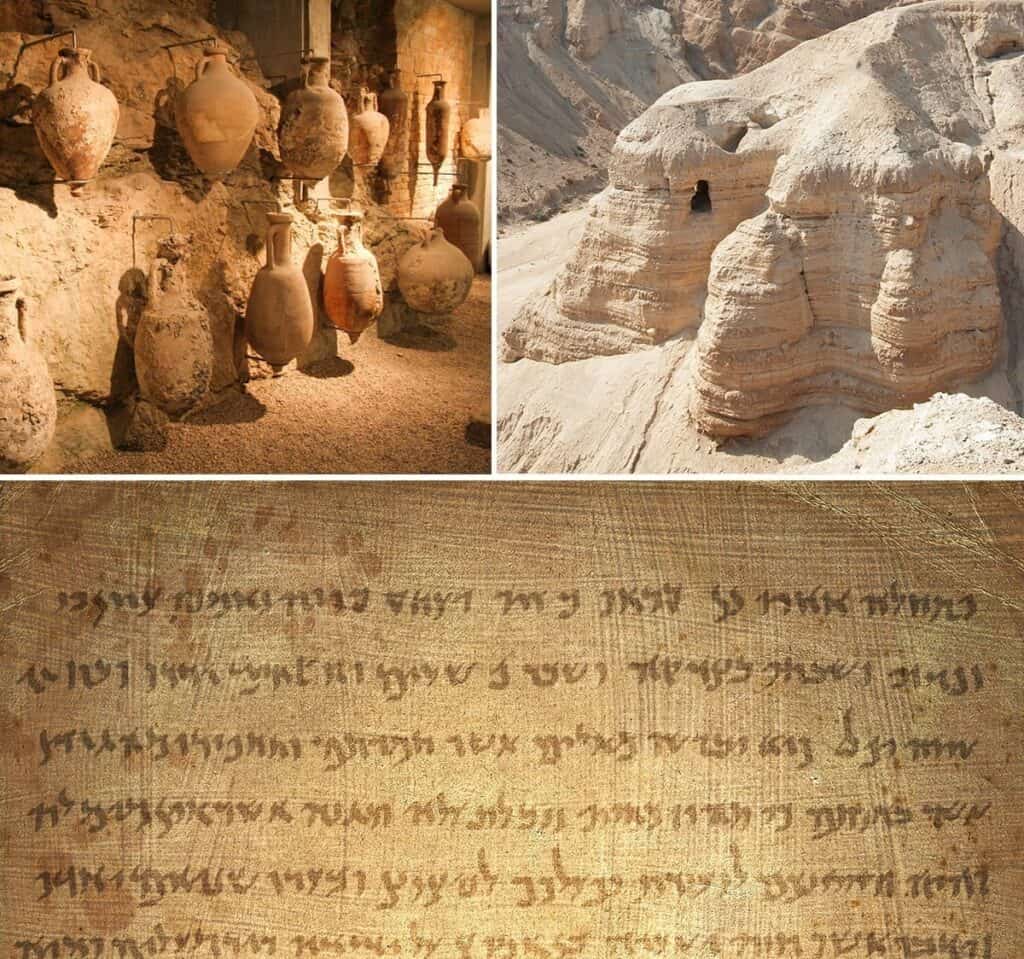
The Dead Sea Scrolls contain manuscripts of books in the Hebrew Bible, which Christians call the Old Testament, plus many other Jewish writings. They do not contain any manuscript accepted as part of the New Testament. Calling the whole collection “Old Testament scrolls” is still incomplete because most of the surviving works are not biblical books.
For the full collection, start with the Dead Sea Scrolls explained guide. This page answers the Bible question directly.
What books of the Hebrew Bible were found?
The Qumran library includes manuscripts representing every book of the Hebrew Bible except Esther. Some survive in substantial sections, while others are tiny fragments. Psalms, Deuteronomy, and Isaiah are especially well represented, but exact manuscript counts depend on how scholars classify fragments and copies.
These manuscripts matter because many are about a thousand years older than the medieval Hebrew codices that previously anchored detailed comparison. They let scholars see how biblical texts circulated during the Second Temple period.
The scrolls do not form one complete ancient Bible bound in a fixed order. They are remains of many manuscripts from different dates, scribes, languages, and textual traditions.
The accurate short answer is: Hebrew Bible manuscripts, yes; New Testament manuscripts, no. The fuller answer is that Qumran preserved a Jewish library containing scripture, interpretation, law, poetry, community rules, liturgy, and other works, not one ancient edition of the Bible.
What else is in the collection?
The scrolls include community rules, legal texts, hymns, prayers, biblical interpretation, calendars, apocalyptic works, and compositions that were previously unknown or known only through later copies. Some are associated with the community that lived at or used Qumran, while the precise identity of that group remains a scholarly question.
Hebrew is the main language, with Aramaic and Greek also represented. The collection reflects a varied Jewish literary world rather than one author’s theology.
The Dead Sea facts guide explains the collection’s physical setting.
For one distinctive nonbiblical work, read the War Scroll guide.
Why are there no New Testament manuscripts?
The Qumran manuscripts are Jewish texts copied from roughly the third century BCE to the first century CE. The site and cave deposits belong to the world of Second Temple Judaism. No manuscript from the collection has been accepted by mainstream scholarship as a New Testament text.
Chronology is part of the answer, but it should not be oversimplified. Some later scrolls overlap the earliest period of the Christian movement, and some New Testament letters were composed before 68 CE. The stronger point is the character of the collection: it is a Jewish library with no identified Christian document.
Similar language about messiahs, scripture, purity, community, or the end of days does not prove that a scroll quotes the New Testament. Both bodies of writing emerged from the wider Jewish world of the period, so shared themes require careful comparison.
What does the Great Isaiah Scroll prove?
The Great Isaiah Scroll dates to around 125 BCE and contains all 66 chapters of Isaiah across 54 columns. At about 7.34 metres long, it is one of the best preserved and most visually impressive biblical manuscripts from Qumran.
Its text is broadly recognizable beside the later Masoretic tradition, while also containing spelling differences, corrections, and textual variants. That combination is the important finding. The scroll demonstrates both continuity and variation, not perfect letter for letter identity across a thousand years.
The Dead Sea historical timeline places the Great Isaiah Scroll in its Second Temple context. Avoid using the manuscript as a slogan that “proves the Bible never changed.” The evidence is more interesting than that claim.
The Great Isaiah Scroll shows remarkable continuity in the book’s recognizable text, but it also preserves corrections and variants. Its significance lies in the chance to study real transmission across centuries, not in forcing a complex manuscript into a claim of perfect copying.
Where were the scrolls found?
The first discovery became known in 1947. Further work identified manuscripts and fragments in eleven caves near Qumran on the northwestern shore of the Dead Sea. The Israel Antiquities Authority describes more than 900 manuscripts represented by tens of thousands of fragments.
Visit the Qumran guide to understand the archaeological site and cave landscape. It also helps distinguish the discovery setting from the museum collection.
The dry cave environment helped preserve parchment and papyrus, but preservation varied greatly. Many fragments are extremely small, damaged, darkened, or difficult to join.
Where can visitors see them?
The Shrine of the Book at the Israel Museum in Jerusalem is associated with major scroll displays, including the Great Isaiah Scroll presentation. Exhibition choices can change, and sensitive manuscripts may be shown through facsimiles or rotating displays.
Qumran provides the archaeological landscape, not the principal manuscript collection. A visitor who wants both contexts can pair the Qumran National Park with an Israel Museum visit on separate parts of a Jerusalem and Dead Sea itinerary.
The Dead Sea history hub places the collection within the wider period.
The biblical history guide shows why scripture, tradition, archaeology and geography should be kept distinct.
Frequently asked questions
Do the Dead Sea Scrolls contain the Old Testament?
They contain manuscripts of books in the Hebrew Bible, called the Old Testament in Christian usage. Every Hebrew Bible book except Esther is represented. The collection is not one complete Bible, and it also includes many Jewish works that are not part of the biblical canon.
Do the Dead Sea Scrolls contain the New Testament?
No accepted New Testament manuscript has been identified among the Qumran scrolls. Some scroll dates overlap the earliest Christian period, so chronology alone is not the whole reason. The collection’s texts, languages, genres, and community setting identify it as a Jewish library of the Second Temple era.
Do the scrolls mention Jesus?
No manuscript accepted as part of the Dead Sea Scrolls names Jesus of Nazareth. Parallels in religious vocabulary or expectation do not amount to a direct reference. Claims that a fragment contains a New Testament phrase require scholarly identification and are not part of the accepted description of the collection.
Is the Great Isaiah Scroll identical to the modern Bible?
No. It contains a highly recognizable form of Isaiah and shows substantial continuity with later Hebrew tradition, but it also includes spelling differences, scribal corrections, and textual variants. Scholars study both the agreement and the differences. “Identical” and “completely changed” are both inaccurate summaries.
Are the Dead Sea Scrolls the oldest biblical manuscripts?
They include some of the oldest surviving manuscripts of books in the Hebrew Bible, but “oldest Bible” is too broad. The fragments vary in date and completeness, and other early biblical materials also exist. The Qumran collection is exceptional for its scale, age, and range.