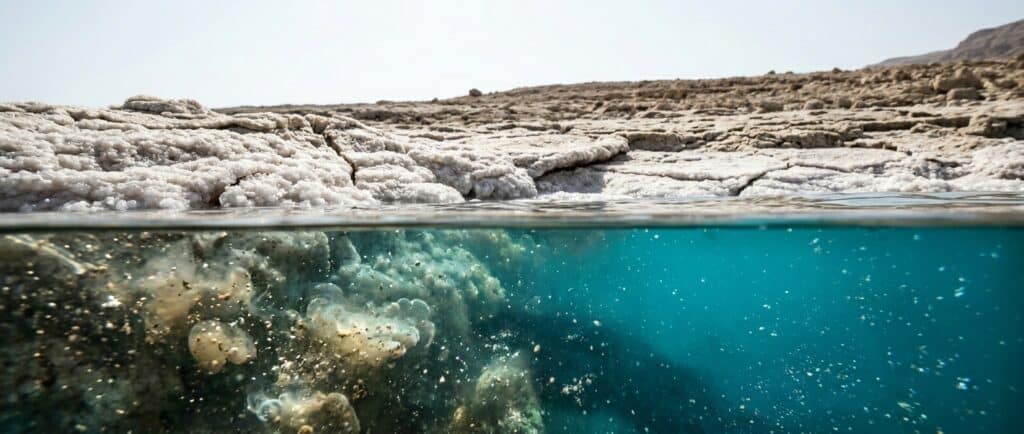
The Dead Sea supports microscopic life, not the familiar ecosystem of fish, plants, and visible animals found in an ordinary lake.
Archaea and bacteria occur in the open brine and sediment. The green alga Dunaliella can multiply after rare dilution events, while freshwater and brackish spring outlets support denser microbial mats. Where a sample comes from is essential to the answer.
The name describes what visitors do not see. It does not mean every habitat in the basin is sterile. The separate no-fish explainer examines the limits faced by larger animals.
Why most life cannot survive in the open water
A Geological Survey of Israel analysis measured total dissolved salts near 340 grams per litre in 2011, roughly ten times the average for ocean water. An unadapted cell exposed to that solution loses moisture across its membrane and struggles to control incoming ions. Its proteins and other internal machinery can stop functioning properly.
Concentration is only part of the challenge. Magnesium, calcium, potassium, sodium, and chloride occur in proportions unlike normal seawater. The high levels of divalent ions, especially magnesium and calcium, make this an unusually severe chemical setting even for many salt-tolerant organisms.
The salinity guide explains how scientists report concentration.
The Dead Sea versus ocean comparison separates the two ion mixtures.
At the scale of a swimmer, the main basin appears empty. At the scale of a microscope, survival depends on specialized cellular chemistry and can change sharply after rainfall, flooding, or mixing.
Archaea and bacteria adapted to salt
Archaea and bacteria are separate domains of life. Both have been identified in Dead Sea samples, although many cells prominent in studies of the most concentrated open brine are archaea.
Some extremely halophilic archaea follow a salt-in strategy. They maintain high internal potassium concentrations, and their proteins are adapted to keep working under those conditions. That mechanism belongs to certain groups; it should not be assigned to every microbe found in the basin.
Bacterial findings depend strongly on the material collected. A surface bottle, shore mud, deep sediment, and a biofilm beside a vent can produce very different results. DNA sequencing can also detect organisms that culture-based methods miss.
One 2015 surface survey analyzed a single one-litre sample and found sequences assigned to both domains. Its percentages describe that date, location, depth, and method, not a permanent census. The Dead Sea bacteria guide follows the evidence at that finer level.
Dunaliella and brief blooms
Dunaliella is a single-celled green alga. It produces glycerol to balance external osmotic pressure without filling its interior with the surrounding ion mixture.
Its presence does not create a permanent green surface. Large growth episodes need unusual dilution and enough nutrients. After heavy rain and floods in the winter of 1991 to 1992, the upper layer became less concentrated and Dunaliella multiplied. Halophilic archaea increased afterward, and their pigments helped turn part of the upper layer red.
A smaller event had been documented in 1980. Both episodes were temporary. They show that a species can belong to this ecosystem yet remain scarce or undetectable during ordinary conditions.
Falling level and changing inflow affect the physical context in which such samples are taken. The water-level guide keeps that environmental trend separate from any prediction of a future bloom.
Underwater springs create local microbial oases
Fresh and brackish groundwater emerges through vents in parts of the lakebed. Around some outlets, lower salinity and added chemical resources allow thick biofilms to develop beside the much sparser ambient community.
A 2012 PLOS ONE field study sampled spring water, nearby sediment, and green and white mats. Cell densities in the sampled springs were 10 to 100 times higher than in the surrounding Dead Sea water. Researchers identified groups including sulfate reducers, nitrifiers, iron-cycling organisms, green sulfur bacteria, and cyanobacteria.
Light, oxygen, sulfide, and mixing differ across each outlet. As a result, one side of a mat may support groups absent a short distance away. These are compact transition zones, not evidence that the entire lake has the same diversity.
The vents were reached by scientific divers using controlled sampling equipment. They are not public swimming attractions. Visitors should enter only through a permitted bathing area and follow the Dead Sea swimming rules.
Why scientists study Dead Sea microbes
These organisms offer models for how membranes, enzymes, genes, and internal chemistry function under strong osmotic and magnesium stress. Comparing a bloom with a non-bloom period can also reveal how quickly an extreme ecosystem responds to dilution and nutrients.
A 2008 NASA Astrobiology Institute project report discussed the Dead Sea as a possible analogue for certain environments proposed for early Mars. The comparison helped frame questions about biological traces under harsh conditions. It did not establish a current NASA mission here or evidence of Martian life.
A peer-reviewed 2024 review examined possible uses for salt-stable enzymes, pigments, polymers, and protective compounds. Those are research prospects. Discovering an organism or molecule does not prove a medical treatment, a consumer benefit, or a commercial process.
Is there life in Dead Sea mud?
Yes. Investigators have recovered microorganisms from shore mud and bottom sediment, where pores, organic material, and chemical gradients differ from the fluid above. Some fungal species and bacterial spores can persist under conditions that allow little active growth.
Sediment results must stay attached to the sampled place and method. Finding a microbe in mud does not provide a lake-wide count, show that the surface contains the same community, or establish a health effect for visitors.
What does not live in the lake itself?
The open Dead Sea has no resident fish population, aquatic plant beds, mollusks, or the familiar crustacean communities found in less concentrated lakes. Rivers and floods may introduce biological material, but arrival does not mean an organism can reproduce and establish itself in the main brine.
Visible wildlife seen near the shore belongs to a different habitat. A bird flying above the surface or an ibex standing on a cliff is part of the regional ecosystem, not an inhabitant of the lake itself.
Life around the Dead Sea
Freshwater, desert cliffs, wadis, saline soils, and oases surround the hypersaline basin. At Ein Gedi Nature Reserve, permanent springs support vegetation, Nubian ibex, rock hyrax, birds, and other animals that could not occupy the open brine.
The rift valley also forms a route for migratory birds. Salt-tolerant plants grow where soil moisture and chemistry permit, while desert species occupy drier ground. These neighboring communities explain why a biologically sparse lake sits inside a visibly active landscape.
The Dead Sea environment guide brings those habitats together with the basin’s water budget, shoreline retreat, and access hazards.
Frequently asked questions
Are there bacteria in the Dead Sea?
Yes. Salt-adapted bacteria have been detected in brine, spring water, sediment, mud, and biofilms. Archaea are a separate domain and are prominent in open-water research, so bacteria are only part of the microscopic community.
Does anything visible live in Dead Sea water?
No resident fish, aquatic vegetation, or familiar lake animals live in the open brine. Rare microbial blooms can change the water’s colour, but the organisms themselves remain microscopic. Wildlife seen nearby belongs to freshwater, shore, or desert habitats.
What is Dunaliella?
Dunaliella is a salt-tolerant, single-celled green alga that accumulates glycerol to manage osmotic pressure. In this basin, major growth requires unusual dilution and nutrient conditions, so it is not a continuous visible layer.
Do underwater springs contain more life?
Some do. A field study found spring-water cell densities 10 to 100 times higher than the surrounding fluid, along with diverse mats near certain outlets. The result applies to those localized samples, not the whole lake.
Can fish survive in the Dead Sea?
Fish cannot establish a population in the open brine because the concentration and ion mixture overwhelm normal osmoregulation. Fresher rivers and springs can support animals within their own chemical range, but those habitats do not change the main basin.
Why do scientists study Dead Sea microbes?
They reveal how cellular machinery can work under severe salt and magnesium stress. Researchers also examine them as models for biological limits and as possible sources of useful compounds, without treating early-stage potential as a proven product or medical benefit.