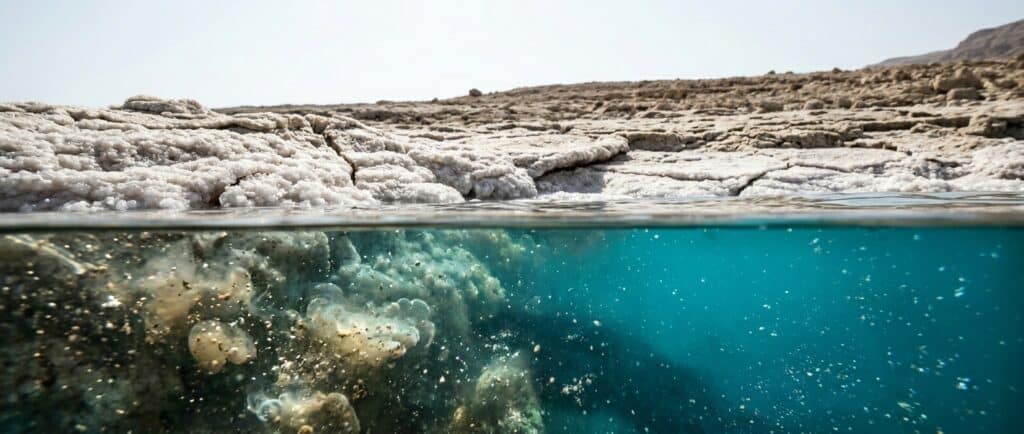
Fish do not live in the open Dead Sea because its concentrated, magnesium-rich brine overwhelms the systems they use to balance water and ions.
The problem is bigger than a high salt reading. The dissolved material is roughly ten times the ocean average, and its chemical proportions differ sharply from ordinary seawater. Even fish adapted to salty lagoons face conditions far beyond their normal range.
The lake is not sterile. Microscopic organisms survive in selected habitats, a distinction explored in the guide to life in the Dead Sea.
What happens to a fish in extreme brine?
A fish must keep the fluid inside its body within a narrow chemical range. Its gills exchange gases while specialized cells move ions, its digestive tract absorbs moisture, and its kidneys help control what is retained or expelled.
In a hypersaline setting, moisture tends to leave the tissues while dissolved ions enter across exposed surfaces. Species that tolerate both rivers and coasts can adjust these processes, but every adaptation has limits. A 2012 review of teleost physiology found that relatively few species tolerate much above 50 parts per thousand. Exceptional salt-tolerant species can manage concentrations above 100 parts per thousand. Those findings show how unusual extreme tolerance is; the review does not identify a species capable of regulating in Dead Sea brine.
Here, extreme concentration combines with unusually high magnesium, calcium, and chloride. The resulting osmotic and ionic stresses affect gills, kidneys, membranes, and proteins together. Ordinary freshwater and marine species cannot maintain the internal balance needed for long-term survival.
There is no defensible universal answer for how quickly an individual animal would die after entering the lake. Species, size, acclimation, temperature, and the chemistry at the entry point would all matter. The supported conclusion is simpler: no resident population occupies the open brine.
Is the Dead Sea ten times saltier than the ocean?
About ten times is useful shorthand, not a permanent laboratory constant. A Geological Survey of Israel analysis measured the concentration near 340 grams of dissolved salts per litre in 2011, while typical ocean water contains close to 35 grams per litre. Values vary by depth, location, date, and method.
Composition matters too. Ordinary seawater is dominated by sodium and chloride. This basin contains much larger proportions of magnesium and calcium, so copying the ocean’s concentration alone would not reproduce the same environment.
The density produced by all that dissolved material explains why people float so easily.
The separate salinity guide follows how researchers measure a solution that changes over time.
Does the Jordan River carry fish into the lake?
The Jordan River brings much less saline water to the northern edge. Suitable freshwater reaches can support aquatic animals, but an inflow does not convert the main basin into a habitable lake.
Where river water and open brine meet, concentration can change steeply across a short distance. A fish remaining in the fresher side of that transition is experiencing a different habitat. Moving into the main body would expose it to progressively harsher chemistry beyond its regulatory capacity.
Local dilution also shifts with flow and mixing, so the boundary is not a fixed refuge that visitors can identify from shore. It should never be treated as a place to approach outside an authorized access area.
What does live in the Dead Sea?
Researchers have documented salt-adapted archaea and bacteria, together with the single-celled green alga Dunaliella. These microorganisms use cellular strategies unavailable to larger animals. Their presence also changes by habitat and season, which is why one sample cannot describe the entire system.
Fresh and brackish springs emerging from the lakebed create narrow transition zones. The 2012 PLOS ONE study Microbial and Chemical Characterization of Underwater Fresh Water Springs in the Dead Sea found denser microbial communities and biofilms around some outlets than in the sparse surrounding fluid. Those vents are research sites, not freshwater ponds containing ordinary aquatic wildlife.
Groundwater movement around the retreating shore is part of the same changing landscape. The Dead Sea environment guide connects that process with exposed ground and sinkhole development.
What visitors should take from the science
You should not expect coral, seaweed, or visible aquatic animals while floating. Clear-looking water does not mean harmless water, and the absence of predators does not remove the risk to eyes, mouth, or damaged skin.
Enter only at a declared bathing site, keep your face above the surface, avoid splashing, and never swallow the liquid. The full Dead Sea swimming rules explain what to do before entering and how to respond if exposure occurs.
Salt crystals and exposed formations are part of the scenery, but changing shore conditions can make improvised access dangerous. The salt formations guide explains the geology within managed-access limits.
Seasonal warmth can change comfort and heat risk without making the ecosystem suitable for larger organisms. Use the water temperature guide when planning a visit, and consult the Dead Sea facts guide for the wider physical context.
Frequently asked questions
Are there any fish in the Dead Sea?
No. There is no resident population in the open Dead Sea. The extreme concentration and unusual ion mixture exceed the regulatory limits of ordinary freshwater, marine, and even highly salt-tolerant species.
Is the Dead Sea completely dead?
No. Archaea, bacteria, and Dunaliella have been documented in its system, while spring outlets and sediment can support localized communities. Most of this biology is microscopic and sparse compared with a conventional lake.
Could a specially adapted fish evolve to live there?
Evolution has produced species that tolerate hypersaline environments, but none is known to maintain a population in the present open brine. Any such adaptation would have to solve several problems at once, including water loss, ion regulation, respiration, and protein stability.
Does anything eat the Dead Sea microorganisms?
This ecosystem should not be pictured as a conventional food web with grazing fish. Different microorganisms use light, dissolved compounds, and material supplied near inflows or springs. Which groups are active depends on the sampled habitat and conditions.
Can fish live where the Jordan River enters?
They can occupy suitable freshwater in the river system or remain on the fresher side of a mixing zone. That does not mean they can move into the open Dead Sea, where the chemistry quickly exceeds their tolerance.