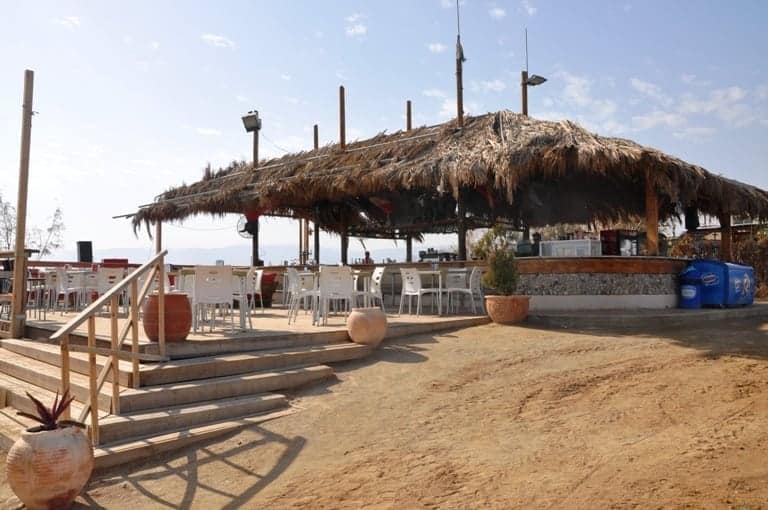
The Dead Sea is a hypersaline terminal lake between Israel and Jordan whose surface stood 441.16 metres below mean sea level on 1 August 2026, according to a dated Israel Water Authority measurement, and these ten facts preserve what is distinctive without turning variable readings or medical research into travel myths.
Pair this page with the Dead Sea first-timer guide and the swimming rules before entering the water.
Elevation, water and minerals
1. Its shoreline is the lowest exposed land surface on Earth
The Dead Sea surface is more than 440 metres below mean sea level. The precise figure changes as the lake level falls, which is why 441.16 metres needs its 1 August 2026 measurement date. Our Dead Sea elevation guide explains why different articles can show slightly different numbers.
Dead Sea elevation is a moving measurement. A date belongs beside a precise number, just as it would beside a lake level or weather reading; “more than 440 metres below sea level” works for orientation, while an exact figure needs its measurement date.
2. It is a lake, not an ocean sea
Water enters the Dead Sea, chiefly through the Jordan River system, but the lake has no outlet to the ocean. Water leaves mainly through evaporation while dissolved salts stay behind; “sea” is the historic name, not a scientific classification.
The deep natural lake is principally in the northern basin. Much of the southern water shown on maps consists of managed evaporation ponds, so one permanent length-and-width figure can mislead as the shoreline retreats.
3. The water is about 34.2 percent salt by mass
Dead Sea brine is roughly ten times as salty as average ocean water, and at 34.2 percent by mass, one kilogram of brine contains about 342 grams of dissolved salts, although the figure is a scale comparison rather than a promise that every sample has the same composition. The concentrated brine is denser than fresh water, increasing buoyancy and making a person sit unusually high at the surface.
It is still possible to lose balance or roll forward. Enter only at a designated bathing area, keep your face out of the water and follow staff instructions; read why people float for the science, then use how to float safely for the step-by-step technique in practice.
4. Its mineral balance differs from seawater
Dead Sea brine contains abundant chloride salts associated with magnesium and sodium, together with calcium and potassium. The balance differs substantially from ordinary seawater. Exact permanent percentages are misleading because results depend on where, when and how a sample is analysed.
For a clear comparison, see Dead Sea versus ocean water.
Geography, change and life
5. Israel and Jordan are separate visitor shores
Israel lies to the west and Jordan to the east. A hotel or beach on one shore is not a casual extension of an itinerary on the other. Use the Israel and Jordan comparison before choosing the country; the Israel Dead Sea activities guide covers the western shore.
The Jordan trip-planning guide covers the eastern shore.
6. The lake is shrinking
Long-term satellite records show major shoreline retreat, while reduced inflow, evaporation and water use in the basin all matter. A useful planning approximation is about one metre of decline per year, but the rate varies and exact comparisons need dated measurements.
Receding water also changes access and contributes to sinkhole hazards, so use managed shore access rather than walking toward water across abandoned or fenced land.
7. “Dead” does not mean sterile
Fish and most familiar aquatic organisms cannot live in the brine, but salt-adapted microorganisms can; studies have identified archaea and bacteria, and unusual rainy periods have sometimes allowed visible microbial blooms. The accurate claim is specialised microbial life, not “nothing lives there.”
The surrounding desert supports a separate terrestrial ecosystem. Ibex, rock hyrax and migratory birds belong to the land around the lake, not to its aquatic life. Official reserve records also identify striped hyenas and wolves in the wider landscape, although that is habitat context rather than a promise that visitors will see them.
Sunlight, history and treatment research
8. The low basin changes the ultraviolet spectrum
Because sunlight reaches the Dead Sea through a longer atmospheric path than it does at higher elevations, long-term measurements found greater attenuation of UVB in the basin than at Beer Sheva, especially at shorter wavelengths, but that physical difference does not remove ultraviolet risk or make extended exposure safe.
The Dead Sea’s low elevation changes the ultraviolet spectrum, but it does not switch UV off. Sunburn and cumulative skin damage remain possible. A scientific finding about relative attenuation should never be rewritten as permission to stay in the sun without ordinary protection.
9. The region has a long written and archaeological history
Biblical texts call the lake the Salt Sea, Sea of the Arabah and Eastern Sea, and connect the surrounding landscape with stories including Sodom, Lot and David at Ein Gedi. Between 1947 and 1956, manuscripts now known as the Dead Sea Scrolls were recovered from caves near Qumran.
Explore what the Dead Sea Scrolls are or the Qumran archaeological site.
10. Supervised Dead Sea climatotherapy has been studied
Clinical research has examined structured Dead Sea climatotherapy, particularly for psoriasis, through individualized schedules of sun exposure and bathing that often continue for several weeks with clinical assessment; studies report short-term improvement in selected patients, while response duration varies and ultraviolet exposure has risks.
That is not the same as an ordinary beach visit, a mud application or a hotel spa day. A traveller should not treat general access to the Dead Sea as medical care or replace prescribed treatment with a holiday.
Medical note
The medical information on this page is general educational context, not diagnosis or treatment advice. Ultraviolet exposure can cause harm, and suitability for climatotherapy depends on the person, condition, medicines and clinical supervision. Consult a qualified clinician first.
Frequently asked questions
Can anything live in the Dead Sea?
Yes, but the brine does not contain fish or support a conventional lake ecosystem. Salt-adapted microorganisms, including archaea, survive in the extreme brine. The surrounding desert has its own animal and plant life, which should not be confused with organisms actually living in the water.
Can you sink in the Dead Sea?
The dense brine makes most people unusually buoyant, but “you cannot sink” is an unsafe absolute. A person can lose balance, roll forward or get water into the eyes and mouth, so use a supervised bathing area and follow local instructions.
Is the Dead Sea exactly 441.16 metres below sea level?
That was the measured surface elevation on 1 August 2026. It is not a timeless value. For general orientation, “more than 440 metres below sea level” remains accurate, but use a dated official measurement when quoting an exact current figure.
Does the lower elevation prevent sunburn?
No. Measurements show relative attenuation of parts of the UV spectrum, not the absence of ultraviolet radiation. Sunburn and long-term skin damage remain possible during an ordinary daytime visit; follow ordinary sun-protection advice rather than extending exposure because of the location.
Is an ordinary Dead Sea visit a medical treatment?
No. Supervised climatotherapy is a structured clinical program studied especially for psoriasis, and neither floating at a public beach nor using a hotel spa reproduces the individualized exposure schedule, clinical assessment and risk management described in that research. Anyone considering treatment should speak with a qualified clinician.