Overview
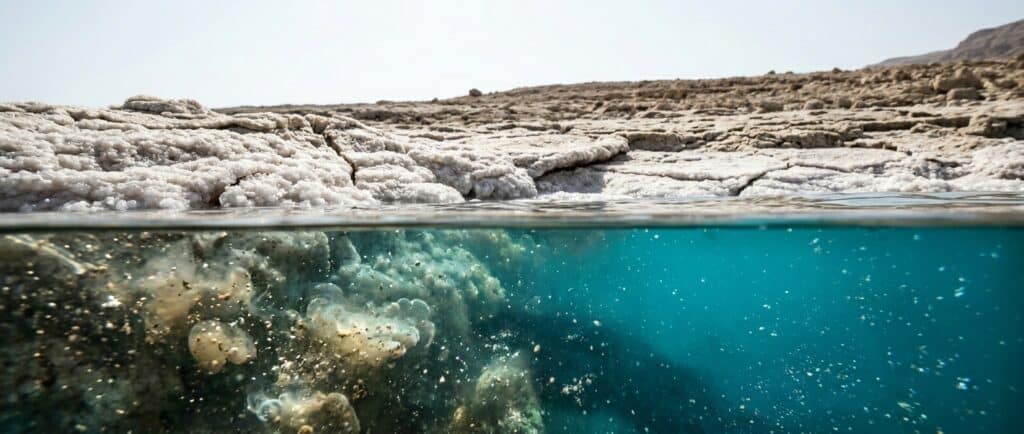
The Dead Sea is called “dead” because its extremely salty water does not support fish, aquatic plants, or the visible marine life people expect in a sea. The name is accurate at that scale, although the water is not sterile: specialized microorganisms can survive there, and rare blooms have appeared after unusually heavy freshwater inflow.
The Dead Sea salinity guide explains the chemistry behind the name. A scientific measurement reported about 340 grams of dissolved salts per liter in 2011, roughly ten times the broad ocean comparison used by the same researchers.
For the map and shore-by-shore orientation, see where the Dead Sea is located.
The short answer
Most fish and aquatic plants cannot live in the Dead Sea’s usual brine. That visible absence led ancient writers to describe the lake as dead, even though earlier cultures also used names based on salt, geography, biblical tradition, and the bitumen that sometimes reached its surface; the modern name therefore describes one striking feature rather than the lake’s complete biology.
For the broader biological answer, read what lives in the Dead Sea.
The separate page on why there are no fish explains the animal limit.
Dead Sea brine measured about 340 grams of dissolved salts per liter in 2011, helping explain why it excludes fish, aquatic plants, and familiar marine animals. Microbial studies tell a more precise story. A small number of highly adapted organisms can persist, while dense visible blooms have required unusual dilution after exceptionally rainy winters.
What was the Dead Sea called before this name?
The Hebrew Bible most often identifies it as Yam HaMelach, the Salt Sea; other biblical names include the Sea of the Arabah and the Eastern Sea. These names describe its chemistry or position rather than an absence of life.
Greek and Roman writers used forms of Asphalt Lake or Asphalt Sea because natural bitumen was associated with the basin and traded in antiquity. A scholarly study of ancient descriptions identifies Diodorus as an early source for the Greek name Asphaltitis Limne. [1] The historian Josephus also used the asphalt name.
The expression translated as “Dead Sea” appears in surviving Greek writing by the second century CE, including Pausanias. It later became the familiar name in many European languages. The Dead Sea history guide follows the wider sequence of names, settlements, and uses around the basin.
By the second century CE, Greek writing had used the expression translated as Dead Sea. Biblical Hebrew emphasized salt and geography, Greek and Roman writers emphasized asphalt, and later usage emphasized the apparent absence of life. Each name records what a particular community noticed or valued most at the time.
What do the Hebrew and Arabic names mean?
In modern Hebrew, Yam HaMelach means Salt Sea. It remains a direct description of the water, and it also connects present usage with the biblical name.
Two Arabic names are widely encountered. Al-Bahr al-Mayyit means the Dead Sea. Bahr Lut, the Sea of Lot, connects the lake with the tradition of Lot and the cities of the plain; the page on the Dead Sea in the Bible provides the religious and historical context without treating every later tradition as a proven location claim.
These names can coexist. One traveler may hear a chemical description, another a literal translation of Dead Sea, and another a name rooted in the Lot tradition.
Is the Dead Sea completely lifeless?
No. The ordinary visitor will not see fish, seaweed, shells, or aquatic plants, but microbiologists have identified salt-adapted life connected with the Dead Sea.
Research on the lake describes the green microalga Dunaliella [2] and extremely halophilic archaea; dense blooms were documented in 1980 and 1992 after unusually rainy winters diluted the upper water layer. The archaea’s pigments helped turn parts of the water reddish during those exceptional events.
Under the lake’s usual extreme conditions, microbial abundance is far lower. That distinction matters. Saying “there are no fish” is supported; saying “nothing at all lives there” is too broad. The Dead Sea bacteria guide covers the organisms and their limits in more detail.
Why is it called a sea when it is a lake?
Geographically, the Dead Sea is a landlocked terminal lake where water enters the basin but no river carries it onward to an ocean. Water leaves mainly through evaporation, while dissolved salts remain and become concentrated.
“Sea” is the traditional name, not a modern classification. Large inland waters have often kept historical sea names long after geographers classified them as lakes. The guide to how the Dead Sea formed explains the closed basin and the fault system beneath it.
The distinction is practical too. Do not expect waves, swimming conditions, or marine life similar to the Mediterranean; the Dead Sea’s dense brine creates a floating experience with its own rules.
What does the name mean for a visitor?
The word “dead” does not mean the water is harmless. Enter only at a managed or declared access point, follow the posted instructions, and keep the water away from your eyes and mouth. The Dead Sea swimming rules explain how to sit back and float without diving, splashing, or immersing your head.
It also does not mean the surrounding landscape lacks life. Springs, desert habitats, migrating birds, and nature reserves belong to the wider basin, even though the lake itself excludes familiar aquatic animals. The Dead Sea environment guide separates the water’s biology from the ecosystems around it.
The name is memorable because it captures the first visual impression, but the fuller answer includes almost no familiar aquatic life, a small and unusual microbial story, and a long record of names shaped by chemistry, history, and belief.
Sources for ancient naming and algal blooms
- Starikova A. Posidonius as a Possible Source of Diodorus’ Description of the Dead Sea (Diod. 2. 48. 6–8; 19. 98–99). Hyperboreus. 2022;27(2):299-315. DOI: 10.36950/hyperboreus.wrb8-yc96.
- Oren A, Gurevich P, Anati DA, Barkan E, Luz B. A bloom of Dunaliella parva in the Dead Sea in 1992: biological and biogeochemical aspects. Hydrobiologia. 1995;297(3):173-185. DOI: 10.1007/BF00019283.
Questions about the Dead Sea's name
Did people always call it the Dead Sea?
No. Biblical Hebrew texts use Salt Sea, Sea of the Arabah, and Eastern Sea. Greek and Roman sources also used Asphalt Lake or Asphalt Sea because of the basin’s bitumen. The name translated as Dead Sea appears in surviving Greek writing by the second century CE and later became the familiar international name.
Is there really no life in the Dead Sea?
There are no fish, aquatic plants, or familiar visible marine communities in the usual brine. Specialized microorganisms have been studied, including Dunaliella and halophilic archaea. Dense blooms in 1980 and 1992 followed unusual dilution of the upper water after exceptionally rainy winters, so they do not describe ordinary conditions.
What does Yam HaMelach mean?
Yam HaMelach means Salt Sea in Hebrew. It is the name used in modern Hebrew and reflects biblical usage; unlike Dead Sea, it describes the lake’s chemistry directly. The two names refer to the same body of water and emphasize different features.
What is the Arabic name for the Dead Sea?
Al-Bahr al-Mayyit means the Dead Sea in Arabic. Bahr Lut, or Sea of Lot, is another traditional Arabic name linked with the Lot narrative; usage varies by place and context, so travelers may encounter either form on maps, signs, and in conversation.
Why did ancient writers call it the Asphalt Lake?
Natural bitumen was associated with the Dead Sea basin and became a valuable ancient commodity. Greek and Roman writers therefore used names meaning Asphalt Lake or Asphalt Sea. That name recorded an economic feature of the lake, just as Salt Sea recorded its chemistry and Dead Sea recorded its visible lack of aquatic life.