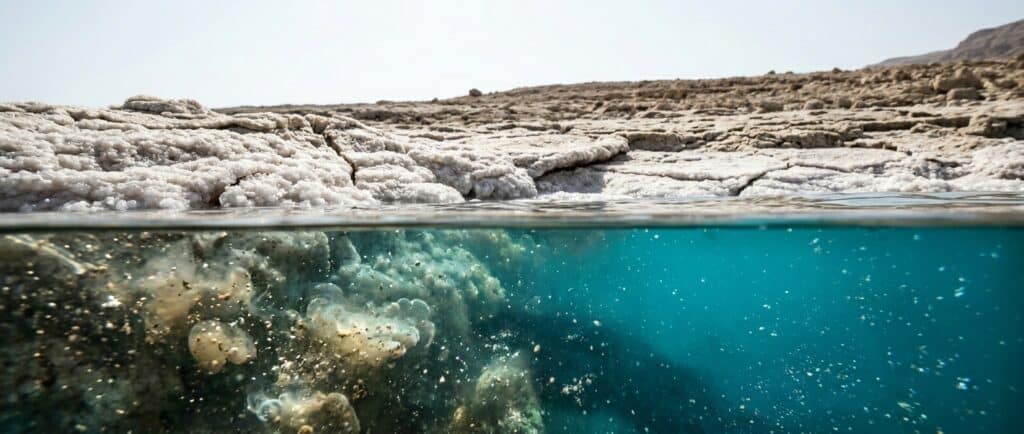
No. Dead Sea water is not safe to drink. Its concentrated brine can disturb blood mineral levels, and water that enters the lungs can cause serious injury. If someone swallows or inhales it, help them leave the water, alert the lifeguard, and obtain medical advice immediately. Do not wait for symptoms or try to calculate a safe amount; use the full Dead Sea safety guide for the other checks to make before entering.
The short answer
Dead Sea water contains far more dissolved salts than ordinary seawater. A Geological Survey of Israel analysis reported brine near 340 grams of dissolved salts per litre and a density near 1.24 kilograms per litre in 2011. The exact composition varies, but the practical conclusion does not: this is water to float in carefully, not water to taste.
Clinical reports describe severe magnesium and calcium disturbances after substantial ingestion during near drowning. A series of 69 patients also documented acute lung injury. Those studies involved serious exposures and do not establish a harmless number of sips or mouthfuls.
A precise lethal dose does not belong in visitor advice. Clinical reports show that Dead Sea ingestion and aspiration can be serious, but they do not provide a reliable do it yourself threshold; the safer decision for a visitor is to obtain immediate help after any possible swallowing or inhalation, especially when the amount is uncertain.
For the chemistry behind the concentration, read the Dead Sea salinity guide and the Dead Sea versus ocean comparison.
What to do after someone swallows the water
Use this sequence at the beach:
- Help the person leave the water without putting yourself in danger.
- Alert the lifeguard or responsible beach medic immediately.
- Call emergency services now for collapse, unconsciousness, a seizure, abnormal breathing, severe breathing difficulty, or rapid confusion or drowsiness. In Israel, call 101. In Jordan, call 911.
- Contact the local poison or medical service and follow its instructions, even if symptoms have not appeared.
- Do not induce vomiting or give food, drinks, or home remedies unless directed; give nothing by mouth if the person is not fully alert.
Do not turn first aid into a kitchen experiment. Forced water, salt solutions, activated charcoal, vomiting, or another improvised remedy can create additional risk. Keep the person’s airway clear, follow the lifeguard and dispatcher, and give nothing by mouth to someone who is not fully alert.
Why the risk is different from an ocean mouthful
Dead Sea brine has a different mineral balance as well as a much higher total salt concentration. Published cases describe very high blood magnesium after ingestion, while the 69 patient series found abnormal calcium, magnesium, and phosphorus in many patients. Lung injury occurred when water was aspirated.
Before help arrives, note when the exposure happened, whether the person coughed or vomited, and any change in breathing, alertness, or coordination.
That does not mean every accidental splash produces the same outcome. It means a traveler cannot judge safety from taste, the apparent size of one mouthful, or the absence of immediate symptoms. Medical staff need the exposure details and the person’s condition, not an internet dose formula.
The dense brine also changes how bodies move at the surface, so read why people float in the Dead Sea before using the step by step floating technique.
What to do if water enters the eyes
Leave the lake and rinse the open eye with plenty of clean, not hot, water for at least 20 minutes. Use a gentle flow and do not rub or press the eye. Remove contact lenses if they come out easily during rinsing, but do not delay the rinse to search for them; seek urgent medical help for severe pain, a change in vision, difficulty opening or moving the eye, or symptoms that continue after rinsing. Locate the fresh water rinse before entering, because facilities differ between beaches.
Prevent the exposure before it happens
Use a managed or declared beach while its lifeguard or responsible operator is on duty. Read the rules posted at that site. On the Israel side, Tamar Regional Council specifically tells bathers not to swallow the water or immerse the head, and advises a slow seated entry.
Keep these habits simple:
- Sit before reclining into a back float.
- Keep your face above the surface.
- Do not dive, swim face down, or splash other people; leave if wind, crowding, or balance makes your position difficult to control.
- Keep children within immediate reach and prevent water play.
- Stay inside the managed access area.
The Israel beach guide and Jordan beach guide lead to separate country options; do not apply one country’s operating rules to the other shore.
Plan for children and visitors who need assistance
Children can move suddenly, splash, or roll forward. An adult should remain close enough to act at once, not supervise from a chair. If a child cannot follow the no splashing and face up rules calmly, keep them out of the water.
Anyone who may have difficulty controlling balance, changing position, communicating distress, or exiting without help should make an assistance plan before entry; the Dead Sea accessibility guide explains which details to confirm with the beach in advance.
Medical note
This article is for informational purposes only and does not constitute medical advice. Consult a qualified healthcare professional about individual health questions. Do not delay emergency care.
Questions visitors ask
Can one sip of Dead Sea water hurt you?
There is no reliable visitor threshold that turns a sip or mouthful into a safe exposure. The amount may be uncertain, and aspiration can matter as well as swallowing. Leave the water, tell the lifeguard what happened, and obtain prompt advice from the local medical or poison service.
Should I make myself vomit after swallowing Dead Sea water?
No. General poisoning guidance says not to induce vomiting unless a poison service or healthcare professional directs it. Vomiting can create choking or aspiration risk. Leave the water, alert the lifeguard, and follow professional instructions instead of using a home remedy.
Should I drink a large bottle of fresh water?
Do not force food or drink after a possible poisoning exposure. A clinician or poison service may give instructions based on the amount, symptoms, age, and medical history. Give nothing by mouth to someone who is drowsy, confused, unconscious, or having difficulty swallowing.
What symptoms make this an emergency?
Call emergency services immediately for unconsciousness, abnormal breathing, severe breathing difficulty, seizure, rapid confusion or drowsiness, or symptoms that quickly worsen after leaving the water; vomiting, coughing, chest symptoms, and marked weakness also need prompt professional assessment. Do not wait for a symptom checklist if the person swallowed or inhaled an uncertain amount.
Is floating still safe if the water is dangerous to drink?
Floating can be managed at an approved beach when the responsible lifeguard or operator is working and the visitor follows the posted rules. Enter slowly, stay face up, avoid splashing. The risk changes quickly if water reaches the mouth or lungs, so control matters more than confidence.