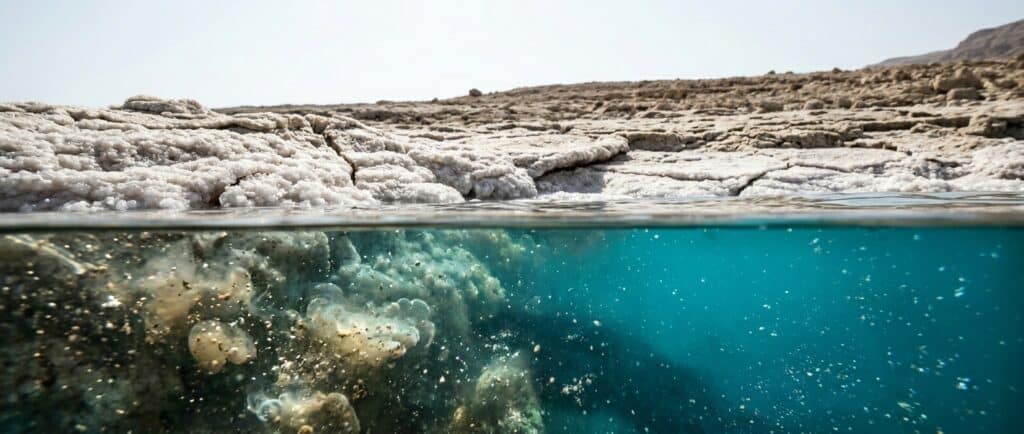
Dead Sea water is about 34 percent salt, close to ten times the salinity of typical ocean water. The exact figure changes with the lake’s water balance and with the way a sample is measured, so 34 percent is best read as a well supported working figure rather than a permanent constant.
That concentration makes the water unusually dense. It is the physical reason people float more easily here than in ordinary seawater. Our guide to why people float in the Dead Sea explains the buoyancy in more detail, while the Dead Sea facts guide puts salinity in the wider geographical picture.
Why the Dead Sea is so salty
The Dead Sea is a terminal lake. Water flows into its basin, but there is no river carrying water out to the ocean. Water leaves mainly through evaporation. The dissolved material it carried does not evaporate with it, so salts remain in the lake or crystallize out when the brine reaches saturation.
This is a long term concentration process, but it is not simply salt accumulating at a fixed rate for millions of years because freshwater inflow, evaporation, groundwater, industrial use and salt-mineral precipitation all affect the chemistry; the lake’s volume and level have also changed sharply in recent decades.
The surrounding rocks and incoming water supply dissolved ions to the basin. As water evaporates, those ions become more concentrated. Some combine into minerals and settle on the lakebed, while others remain dissolved in the brine.
What is dissolved in Dead Sea water?
Calling the water “34 percent salt” does not mean that it is simply a stronger version of table salt. Chemical monitoring shows high concentrations of chloride, magnesium, sodium, calcium, and potassium ions. In a long term scientific record covering 1987 to 2008, chloride was the most abundant measured ion, followed by magnesium, sodium, calcium, and potassium.
It is easy to turn those ion measurements into misleading recipes. Percentages for individual chlorides depend on how the analysis groups dissolved ions into hypothetical salts; for that reason, a neat formula such as “half magnesium chloride” can look more certain than the water chemistry actually allows.
The most useful comparison is straightforward: ocean water is dominated by sodium and chloride, while Dead Sea brine contains an unusually large magnesium and calcium component. This difference helps explain why Dead Sea water tastes and feels unlike ordinary seawater, although it should never be tasted or swallowed.
Salinity and density are related, but not identical
Salinity describes the amount of dissolved material in water. Density describes mass per unit of volume. Dissolved salts add mass, so highly saline water is generally denser than fresh water.
In the 1987 to 2008 monitoring record, Dead Sea surface water density rose from about 1.204 to 1.239 grams per cubic centimeter. The average across the record was about 1.238. Fresh water near ordinary room conditions is close to 1 gram per milliliter, which helps show why the contrast is so noticeable.
An object floats when it displaces enough fluid to balance its weight. Dense Dead Sea brine can support more weight for the same displaced volume than fresh water can. That does not mean everything floats. A dense stone still sinks, and an object’s overall density, including any enclosed air, matters more than its label or shape alone. See our Dead Sea float guide for examples.
Is the Dead Sea becoming saltier?
Official Israeli sources describe a long term decline of roughly one meter per year, while monthly measurements record the actual rate and level at specific dates. A dated measurement is more useful than an undated “current level.” As the volume changes, the concentration and mineral balance can also change.
The answer is therefore more nuanced than a simple yes. Scientific records show that salinity and density increased during parts of the late twentieth and early twenty first centuries. At the same time, halite, or sodium chloride, can crystallize and settle out of the brine; water input, evaporation, and mineral precipitation act together, so the concentration of every component does not rise in a straight line.
For a closer look at the lake’s changing shoreline, read the Dead Sea water level guide.
The environment overview explains the wider basin changes.
What the salinity means for visitors
High salinity creates the famous floating experience, but it also makes the water unforgiving; even a small splash can sting the eyes, and water in the mouth is dangerous. Enter slowly, remain in a supervised bathing area, follow the lifeguard’s instructions, and avoid diving or swimming face down.
If water reaches your eyes, leave the water and rinse with fresh water. Do not rub them. Review the Dead Sea swimming rules and the guide to salt water in the eyes before your first float.
Salinity explains the physics of the experience. It does not by itself prove a medical benefit, and the chemical composition should not be turned into a treatment promise. Anyone visiting for a medical condition should follow professional medical advice rather than a general travel guide.
Frequently asked questions
What percentage salt is the Dead Sea?
About 34 percent is a useful rounded figure. A 2017 scientific sample measured 34 percent salinity, while a long term monitoring record found values that varied over time. The number depends on the date, depth, location, and measurement method, so it should not be treated as a permanent constant.
Is the Dead Sea exactly ten times saltier than the ocean?
“About ten times” is a clear comparison, not an exact universal ratio. Typical ocean water is around 3.5 percent salt, while Dead Sea water is around 34 percent. Both values vary, so the ratio also varies. Use the comparison as a rounded travel fact rather than a laboratory constant.
Is Dead Sea salt just sodium chloride?
No. The brine contains chloride together with substantial magnesium, sodium, calcium, and potassium ions. Table salt is mainly sodium chloride, so it is not a good chemical substitute for natural Dead Sea brine. This wider ion mix is why a simple table-salt recipe cannot reproduce the lake’s chemistry.
Does everything float in the Dead Sea?
No. Floating depends on an object’s overall density and the amount of brine it displaces; people are supported more easily than in fresh water, but dense objects such as many rocks can still sink. A sealed air-filled object may float, while a compact solid object made from dense material may not.
Can you drink Dead Sea water?
No. The extreme salt and mineral concentration makes swallowing it dangerous. If water enters your mouth, leave the water. If you have swallowed or inhaled Dead Sea water, or think you may have, get help immediately from the lifeguard or local medical service. Do not wait for symptoms. The first time visitor guide covers the safe sequence for entering, floating, and rinsing off.