By DeadSea.com Editorial
Last reviewed: September 2026
The Dead Sea appears in the Hebrew Bible as a boundary, a refuge, a place of judgment and the setting for a vision of renewal. Its shore also holds archaeological sites from the same broad historical landscape, including Ein Gedi, Qumran and Masada; together, those sources reward careful reading, provided that biblical tradition, ancient testimony and archaeological evidence are not treated as interchangeable.
This guide follows the main biblical references, then looks at what archaeology can and cannot tell us about the places around the lake. For a wider introduction to the region, begin with the Dead Sea articles and travel guides or the historical timeline of the Dead Sea.
What is the Dead Sea called in the Bible?
The familiar English name “Dead Sea” is not the principal name used in the Hebrew Bible. Several texts call it the Salt Sea. Its Hebrew name is Yam HaMelach. Genesis 14:3 identifies the Valley of Siddim with the Salt Sea, while Numbers 34:12 uses the sea as part of a territorial boundary.
Deuteronomy 3:17 calls it the Sea of the Arabah, a name that places it within the long rift valley south of the Sea of Galilee. Ezekiel 47:18 refers to the Eastern Sea, reflecting its position east of Jerusalem and the central highlands. These names do different work in different passages; one describes the water, another the surrounding geography, and another its direction from the land of Israel.
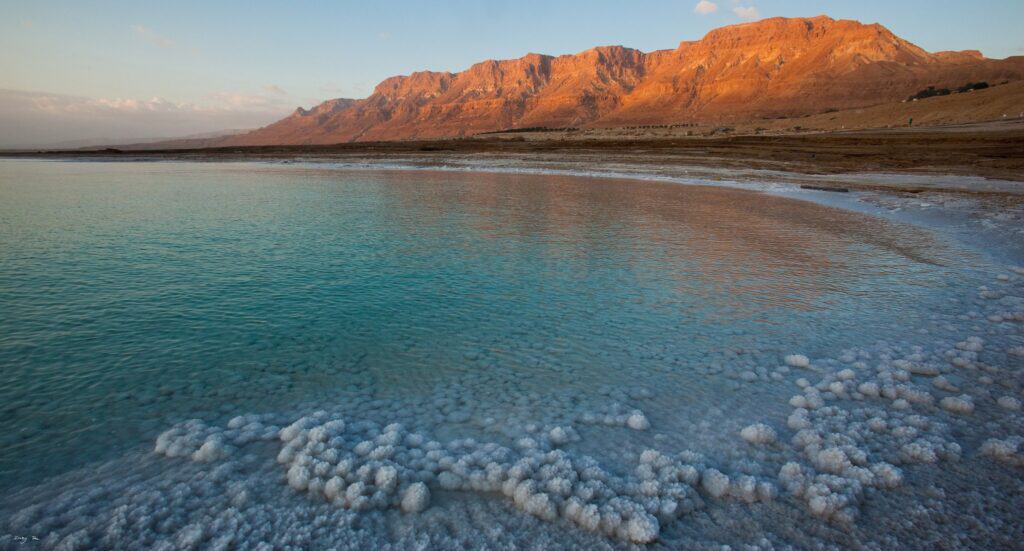
The lake’s extreme character helps explain the durability of the Salt Sea name. Dead Sea brine is about 34.2 percent salt, roughly ten times the average salinity of ocean water. The physical setting behind that name is explored in our guides to Dead Sea salinity and why it is called the Dead Sea.
The biblical names are a useful map in themselves. “Salt Sea” describes the water, “Sea of the Arabah” places it within the rift valley, and “Eastern Sea” locates it in relation to Jerusalem and the highlands. The names overlap, but they are not simply decorative alternatives.
Genesis, the Valley of Siddim and Sodom
Genesis 14 sets a battle among kings in the Valley of Siddim, which the text identifies with the Salt Sea. The chapter mentions bitumen pits. That detail fits a region long known for natural asphalt, also called bitumen; scientific analyses have traced Dead Sea bitumen in archaeological materials and Egyptian funerary substances, showing that it became a traded resource in antiquity.
Genesis 19 places the destruction of Sodom and Gomorrah within the wider region of the cities of the plain. Several archaeological sites around the southern basin have been proposed as possible locations, including Bronze Age settlements east of the lake. None has been conclusively identified as a biblical city. The geography, dating and interpretation remain debated, so archaeology should not be presented as proof of the narrative.
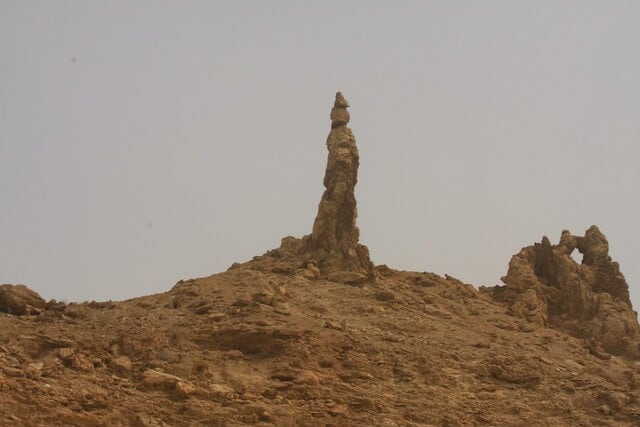
Mount Sodom on the southwestern side of the basin is a ridge formed largely from salt. A prominent pillar is traditionally known as Lot’s Wife; the formation provides a striking physical connection to the story, but its geology does not establish a specific historical event. Our fuller guide to Sodom and Gomorrah keeps the biblical account, regional geography and archaeological proposals in separate lanes.
The southern Dead Sea gives the Genesis story a real geographic frame of salt, desert and ancient settlement. It does not provide a confirmed address for Sodom or Gomorrah; proposed sites remain scholarly interpretations, and the salt pillar called Lot’s Wife belongs to a living tradition rather than archaeological proof.
A boundary in Numbers, Deuteronomy and Joshua
In Numbers 34, the Salt Sea helps define the southern and eastern extent of the land described in the chapter. Deuteronomy 3:17 places the Sea of the Arabah below the slopes of Pisgah, while Joshua repeatedly uses the Salt Sea as a geographic reference point.
These passages show that the lake was not merely symbolic. It was a major feature by which territory could be described because a large saline lake bordered by steep desert terrain made an unmistakable landmark, and modern readers can follow that physical setting through where the Dead Sea is located and the guide to its depth and dimensions.
The Dead Sea also appears in prophetic writing as the Eastern Sea. Joel 2:20 contrasts it with the western sea, while Zechariah 14:8 imagines water flowing from Jerusalem toward both seas. In these passages, familiar geography becomes part of a larger prophetic vision.
Ezekiel’s vision of living water
Ezekiel 47 contains the Bible’s most vivid reversal of the Dead Sea’s natural condition. Water flows east from the Temple, descends through the Arabah and enters the sea; in the vision, the water is healed and supports an abundance of fish. Fishermen stand along the shore from Ein Gedi to Ein Eglaim, while salty marshes remain.
The passage depends on the audience understanding the lake as a place where ordinary fish do not live. That contrast gives the vision its force. It is a prophetic image of restoration, not a report of an ancient environmental event. Readers interested in the natural background can compare it with why there are no fish in the Dead Sea and what lives in the Dead Sea today.
Ezekiel’s reference to Ein Gedi also shows that the oasis was an established geographic marker. Freshwater flowing through a dry landscape makes Ein Gedi Nature Reserve one of the clearest natural contrasts with the saline lake below.
David, the Song of Songs and Ein Gedi
Ein Gedi appears in two very different biblical settings. In 1 Samuel 23 and 24, David takes refuge in the wilderness of Ein Gedi while fleeing Saul. The caves, cliffs and water sources make the location understandable as a desert refuge; the text’s best-known episode occurs when David encounters Saul in a cave and spares his life.
Song of Songs 1:14 evokes henna blossoms in the vineyards of Ein Gedi. Here the oasis is not a military refuge but a cultivated, fragrant place. Both uses draw on the same environmental fact: reliable spring water creates a fertile pocket in an otherwise arid region.
Archaeology adds a longer story. It is not continuous. The earliest remains in the oasis area reach back about 5,000 years, while permanent settlement developed much later. A Jewish village flourished in the Roman and Byzantine periods, and the remains of its synagogue can be visited at the Ein Gedi ancient synagogue. This evidence supports Ein Gedi’s long importance, but it should not be described as one uninterrupted settlement lasting five millennia.
Ein Gedi’s biblical roles make sense when the landscape is kept in view. Caves and cliffs offered concealment, while perennial springs supported cultivation. Archaeology reveals repeated human use across thousands of years, with gaps and changing settlements rather than a single community living there without interruption.
Qumran and the Dead Sea Scrolls
Between 1947 and 1956, manuscripts and fragments were found in eleven caves near Qumran on the northwestern shore; the collection now known as the Dead Sea Scrolls includes more than 900 texts written mainly in Hebrew and Aramaic, with some Greek. Biblical manuscripts represent every book of the Hebrew Bible except Esther, alongside community rules, commentaries, prayers, legal texts and other Jewish writings from the late Second Temple period.
The scrolls do not retell the Dead Sea’s biblical geography. Their importance lies in preserving Jewish texts from more than two thousand years ago, including biblical manuscripts far older than the medieval Hebrew codices once central to textual comparison. Some readings are close to the later Masoretic tradition; others preserve variants that show a period in which more than one textual form circulated.
Qumran is often associated with the Essenes, a Jewish group described by ancient writers. That connection remains influential, but the collection should not be reduced to a single author or community. The Israel Antiquities Authority describes the scrolls as reflecting communities that changed over time, and scholars continue to discuss how manuscripts from different origins reached the caves; our guide to the Essenes and the Dead Sea Scrolls explores the argument without presenting it as settled fact.
The nearby Qumran archaeological site preserves buildings, pools and water installations from the settlement. These remains help explain life at the site, while the caves and manuscripts provide a separate body of evidence. The settlement, the people who used it and the origins of every scroll are related questions, not a single proven answer.
Herod, Masada and the Roman period
Masada rises from the Judean Desert west of the Dead Sea. Herod the Great developed the mountain as a fortified palace complex, with storerooms, cisterns, baths and palaces adapted to an isolated desert summit. UNESCO inscribed Masada as a World Heritage Site in 2001.
The site is also associated with the final stage of the First Jewish Revolt against Rome. Josephus describes a siege by the Roman Tenth Legion and the fall of the fortress in 73 CE. Archaeology confirms the Roman siege works and extensive occupation remains, while historians continue to examine how particular parts of Josephus’s account should be read; the distinction matters: the siege is archaeologically visible, but not every narrative detail has equal independent support.
Herod also built at other points around the basin, including Machaerus east of the Dead Sea. Together, these sites show how rulers used the region’s high ground, difficult approaches and water engineering. The Masada National Park guide covers the Israeli visitor site, while King Herod and the Dead Sea looks more closely at his building program.
The Roman-period record extends beyond royal architecture. Caves in the Judean Desert preserved letters and personal documents connected with the Bar Kokhba Revolt. The Cave of Letters included a group of documents belonging to Babatha, a Jewish woman whose legal and financial archive offers an unusually detailed view of family and property life in the early second century CE.
Greek and Roman descriptions of the lake
Ancient Mediterranean writers were fascinated by the lake’s density, salt and asphalt. Diodorus Siculus discussed the asphalt trade, while Pliny the Elder and Josephus described the water and surrounding country. Their accounts are valuable evidence for how outsiders understood the region, but they combine observation, report and literary convention.
Modern chemistry strengthens one part. Dead Sea bitumen has been identified in archaeological materials far beyond the basin, including substances used in Egypt. This shows that the lake was linked to regional trade over long periods. It is safer to describe a changing trade network than to assign every shipment to one people or ruler.
Diodorus places Nabataeans within the Hellenistic struggle over Dead Sea asphalt and describes the material being sold in Egypt for embalming; Josephus later records that Mark Antony granted Cleopatra revenues around Jericho, including its valuable balsam-growing district, which Herod leased from her. These accounts connect the basin to wider political and commercial networks, although they should be read as ancient testimony rather than modern economic records.
Jericho and the Jordan River
The wider biblical landscape extends north of the lake. Joshua 3 describes the Israelites crossing the Jordan before entering the land, and the Synoptic Gospels place the baptism of Jesus in the Jordan. The river is also the Dead Sea’s principal natural inflow, so its religious and environmental histories meet within the same basin.
Ancient Jericho, at Tell es-Sultan, preserves archaeological deposits of human activity reaching back to about 10,500 BCE; UNESCO describes 29 phases of occupation, a record that makes repeated settlement and change clearer than a claim of uninterrupted habitation. Jericho appears throughout biblical literature, but individual archaeological layers must be interpreted on their own evidence.
Modern archaeology around the Dead Sea
Twentieth-century discoveries and excavations transformed knowledge of the region. The scroll caves and Qumran settlement were investigated after the first manuscript discoveries in 1947. Yigael Yadin directed major excavations at Masada in two seasons from 1963 to 1965, building on earlier surveys and excavations; Ein Gedi, Judean Desert refuge caves and sites east of the lake have been studied by Israeli, Jordanian and international teams.
That work produced different kinds of evidence: architecture at Masada, manuscripts near Qumran, village and synagogue remains at Ein Gedi, and personal archives from desert caves. Each body of evidence answers a different historical question and belongs to a particular country, period and site.
How to read the Dead Sea’s biblical landscape
The strongest way to understand the region is to let each kind of evidence answer its own question. Biblical texts preserve names, narratives and theological meanings. Archaeology documents settlements, buildings, manuscripts and material culture. Geology explains the salt ridge, basin and brine; ancient historians add perspectives shaped by their own periods and purposes.
Those sources often illuminate one another, but they do not always confirm one another. A proposed biblical site is not a proven identification, a traditional place-name is not a date, and a later historian is not an eyewitness to every event described. Keeping those boundaries visible makes the Dead Sea’s history more compelling, not less.
Its landscape is also changing. On 4 October 2026, the Israel Water Authority recorded the water surface at 441.50 metres below mean sea level. The long-term decline is often summarized as roughly one metre per year, but the rate varies and exact comparisons need dated measurements.
As the shore retreats, groundwater can dissolve buried salt and contribute to Dead Sea sinkholes.
The Dead Sea environment guide explains the modern pressures without turning ancient history into a claim about current policy.
Frequently asked questions
How many times is the Dead Sea mentioned in the Bible?
The answer depends on which names and passages are counted. The Hebrew Bible refers to the lake as the Salt Sea, the Sea of the Arabah and the Eastern Sea in several books. It is more accurate to identify the passages and names than to offer one fixed total that may change with translation and counting method.
Is Sodom’s location known?
No archaeological site has been conclusively identified as Sodom; researchers have proposed locations around the southern Dead Sea, including Bronze Age settlements east of the lake, but the evidence and interpretation remain debated. Mount Sodom and the pillar called Lot’s Wife are important geographic and traditional associations, not proof of a specific city.
What happened at Ein Gedi in the Bible?
In 1 Samuel, David hides in the wilderness of Ein Gedi while fleeing Saul, and he spares Saul during an encounter in a cave. Song of Songs associates Ein Gedi with vineyards and henna blossoms. Ezekiel 47 names it as a landmark in the prophetic vision of a renewed sea.
Are the Dead Sea Scrolls biblical manuscripts?
Some are. The collection includes manuscripts from every book of the Hebrew Bible except Esther, as well as many nonbiblical Jewish works, community texts, prayers and commentaries; the Great Isaiah Scroll is among the best-known biblical manuscripts, but it is only one part of a much broader library.
Did the Essenes write all the Dead Sea Scrolls?
Qumran has long been associated with the Essenes, but the identity of the people who collected, copied or deposited every manuscript is not settled. The scrolls include works with different origins and dates. Current scholarship allows for a more complex history than a single community writing the entire collection.
Is Masada mentioned in the Bible?
Masada is not named in the Hebrew Bible. Its best-known history belongs to the late Second Temple and Roman periods, especially Herod’s fortified palace and the Roman siege described by Josephus. The site is part of the Dead Sea’s wider historical landscape rather than a biblical location in the strict sense.