


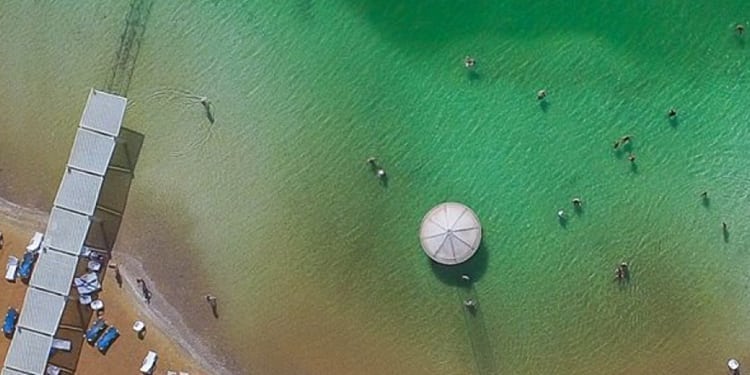

The Dead Sea, bordered on one side by Jordan and on the other side by Israel, is a natural wonder visited by many tourists every year. The lowest point on Earth, it is also one of the saltiest bodies of water in the world.
Its light turquoise color, the white salt crystals on its shores and protruding from its waters, and the golden-brown mountains surrounding it, make the Dead Sea landscape surreal and uniquely beautiful.
Why is it called the Dead Sea?
One of the reasons why The Dead Sea’s name was given to it is that no creature can live in its hyper-salty water. On top of that, the climate in the Dead Sea is characterized by:
- Dry air and minimal rainfall.
- Low precipitation throughout the year.
- Very high temperatures with over 30°C (86°F) for more than 6 months annually, and sometimes peaking above 45°C (113°F)
These extreme conditions create a harsh environment for life. But is it true that the Dead Sea is “dead”? Or is there life in the Dead Sea after all? The answer might surprise you. So if you’re wondering what lives in the Dead Sea, keep reading.
What lives in the Dead Sea?
While it’s true that higher organisms (fish, for example) can’t survive in the Dead Sea’s water, several microorganisms can. In fact, several bacteria and microscopic algae live in the Dead Sea. These microorganisms can survive there because they are well adapted to hyper-salinity conditions.
Microscopic Life in the Dead Sea
So, is there life in the Dead Sea? Yes, but not the kind you can see with the naked eye. Despite the extreme salinity, a fascinating microscopic Dead Sea ecosystem exists beneath the surface.
Here’s what thrives in the Dead Sea:
- Halophilic bacteria, or salt-loving microbes that tolerate extreme salt levels.
- Dunaliella algae, a rare microalga that gives the water a reddish hue after rainfall or flooding.
- Cyanobacteria and green sulfur bacteria are found near fresh water sources at the bottom.
- Nearly 80 species of fungi, some newly discovered and unique to the Dead Sea region.
These microorganisms are capable of surviving in one of the harshest environments on Earth, proving that the Dead Sea is far from “dead.”
When the Dead Sea Turns Red
During very rainy periods or floods, the influx of fresh water changes the Dead Sea’s chemical makeup, thus increasing the volume and number of microorganisms living there.
In such periods, people have witnessed the water’s surface turning a bright red, indicating the presence of Dunaliella algae, a key Dead Sea creature at the microbial level. This phenomenon is temporary but spectacular, showing nature’s adaptability even in extreme habitats.
Hidden Freshwater Springs and Microbial Diversity
A little-known fact is that the Dead Sea itself actually contains freshwater springs that are found at its bottom. Near these springs, more types of microorganisms can be found, including:
- Single-celled algae
- Cyanobacteria
- Green sulfur bacteria
Other microorganisms that were found at the bottom of the Dead Sea include nearly 80 species of fungi. What’s even more interesting is that many of the microorganisms found in the Dead Sea are unique creatures, some of which have not been previously known to science.
So, if you’ve ever asked “Does Dead Sea have any life?”, the answer is yes, microscopic life forms not seen anywhere else on Earth
Dead Sea Wildlife
Dead Sea animals do not include only those found inside the sea, but also those found in its surrounding area. The Dead Sea ecosystem extends well beyond the waterline.
The Jordan Rift Valley, where the Dead Sea is located, serves as a migration corridor for numerous animal species. These include:
- Storks and various birds of prey on their seasonal migration to Africa.
- Jungle cats (swamp cats) and marsh frogs.
- European green toads, crabs, snails, and diverse water insects.
This combination of desert, water, and high mineral content creates a unique balance of biodiversity rarely seen elsewhere.
Animals Around the Dead Sea Region
Further away from the shores of the Dead Sea, in the more mountainous area, ibexes and hyraxes can be found; and where the area borders the desert, wolves, foxes, and the occasional hyena can be seen during night time.
These land-based species form part of the wider Dead Sea ecosystem, which combines desert and freshwater elements to support life on its fringes.
Visit the Dead Sea creatures
If you wish to see typical animals of the Dead Sea area up close, a good place to visit would be the Ein Gedi, one of Israel’s most biodiverse natural parks.
Here, you can encounter:
- One of the largest groups of ibexes in Israel.
- Hyraxes, foxes, wolves, bats, snakes, frogs, crabs, and various birds.
This nearby oasis demonstrates that the Dead Sea ecosystem extends well beyond the water itself, nurturing a surprising variety of wildlife in an otherwise arid landscape.
The Living Paradox of the Dead Sea
So as you can see, the Dead Sea is actually not dead at all. There’s life in the Dead Sea and all around it, and quite an interesting life, too.
If you’re a nature lover and would like to gain a better knowledge of Dead Sea animals and the broader Dead Sea ecosystem, just open your eyes, look around, and explore.
Frequently Asked Questions
- Q: What types of microorganisms are found in the Dead Sea?
A: The Dead Sea contains salt-tolerant microorganisms, mainly halophilic bacteria and algae that can survive its extreme salinity. These microorganisms appear only under specific conditions, such as after heavy rainfall. - Q: Are there any fish or larger animals living in the Dead Sea?
A: No, fish and larger animals cannot survive in the Dead Sea due to its extremely high salt concentration, which makes it uninhabitable for most aquatic life. - Q: Does wildlife exist around the shores of the Dead Sea, even if not in the water itself?
A: Yes, while the water itself does not support larger life, the surrounding areas are home to birds, plants, and desert animals that rely on nearby freshwater springs and oases.